Snow fungus (银耳): the skin-nourishing dessert
yin er (银耳)
Snow fungus, yin er, is the ruffled white mushroom that cooks into a silky, collagen-like dessert. Why it is the poor man's bird's nest, and how to use it.
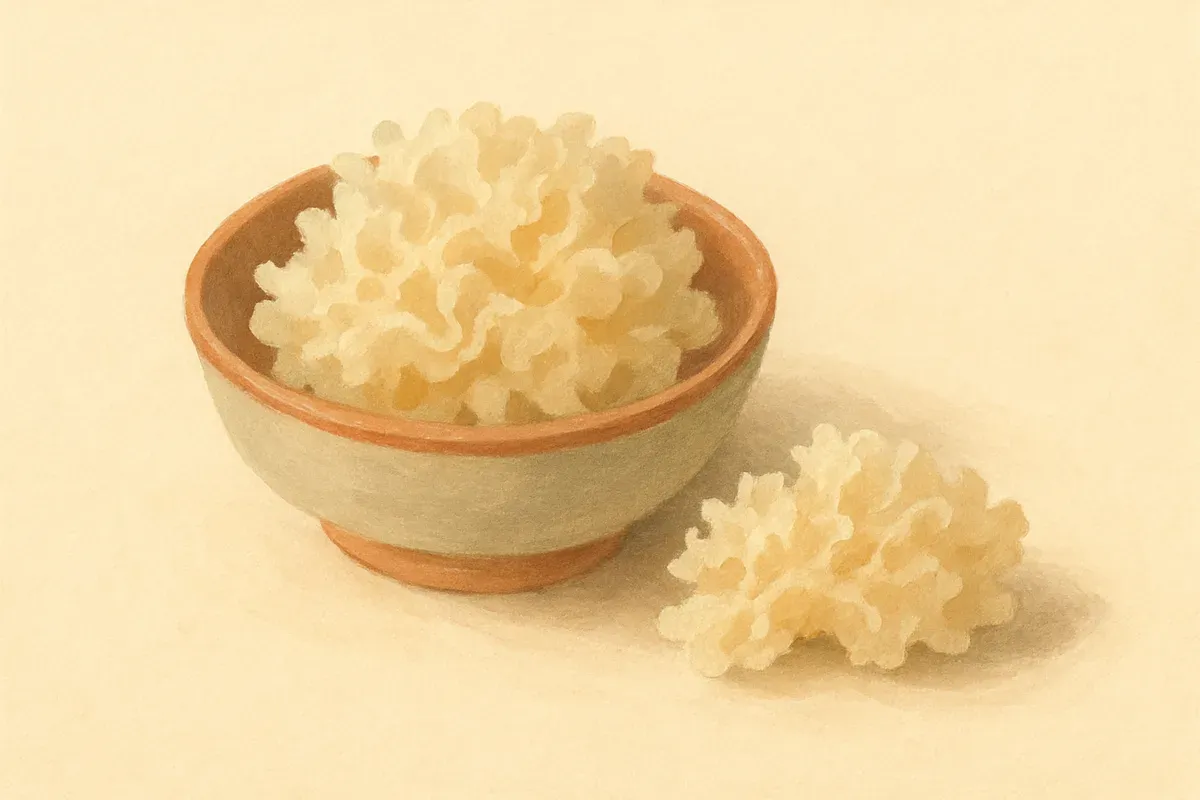
Dried, snow fungus looks like a pale, crinkled flower. Cooked slowly, it dissolves at the edges into something silky and just-set, and that transformation is why it has been a fixture of the Chinese dessert table, and the confinement one, for generations.
Why yin and skin
In TCM, snow fungus is valued to nourish yin, the body’s cooling and moistening side, and to moisten the lungs. Alongside that runs a long folk reputation as a food for the skin and complexion, which is much of why it endures. For a recovering mother it offers something the warming savoury tonics do not: a soft, gently moistening dish, easy to eat and easy on the appetite.
The poor man’s bird’s nest
Snow fungus is often called the poor man’s bird’s nest, and the comparison is a fair one. It gives a similar soft, gelatinous, collagen-like texture and carries the same yin-and-skin reputation as the famously expensive delicacy, for a tiny fraction of the cost. Like peach gum, it is a plant-world route to that prized silky texture, without the price tag.
In the kitchen
Its natural home is the sweet soup: simmered with red dates, goji berries, a little rock sugar, and often peach gum or lotus seed, into a warm, nourishing dessert. But it is at home in savoury cooking too, as in broccoli with white fungus and goji, one of the lighter confinement dishes. Soak it, trim the hard yellow base, tear it up, and simmer until soft.
Buying it well
Choose fungus that is pale cream to light yellow rather than a stark, bleached white, which can be a sign of over-processing. The pieces should be whole and springy, not crumbling. Kept airtight and dry, they last for many months.
Sources
- The Zuo Yuezi Guide
- Zuo Yuezi: An American Mother's Guide to Chinese Postpartum Recovery (Guang Ming Whitley)
Common questions
What is snow fungus?
It is a pale, frilly edible fungus, also sold as white fungus, silver fungus or tremella. Dried, it looks like a crinkled flower; soaked and simmered, it turns soft and gelatinous with a mild flavour that takes on whatever it is cooked with, sweet or savoury.
Why is it called the poor man's bird's nest?
Because it offers a similar soft, gelatinous texture and the same yin-nourishing, skin-food reputation as costly bird's nest, at a small fraction of the price. For most everyday confinement cooking it does the same job.
How do I prepare it?
Soak the dried fungus in cool water for twenty to thirty minutes until it opens out and softens, cut away the tough yellow base, and tear it into bite-sized pieces. Then simmer it, often for thirty to sixty minutes, until it is soft and the liquid turns silky.