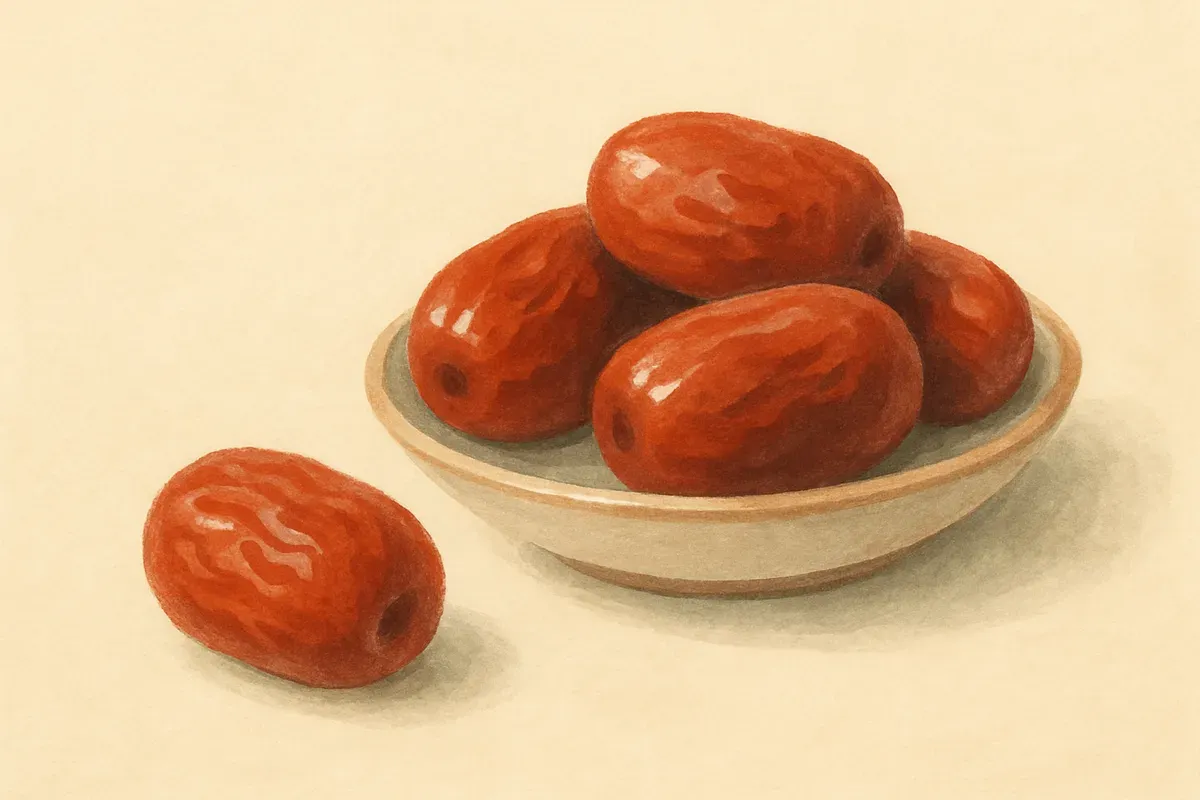
Red dates (红枣): the confinement blood tonic
hong zao (红枣)
Red dates appear in almost every confinement soup and tea. Why the tradition treats them as a blood tonic, how they harmonise a dish, and how to prepare them.
Open any confinement recipe and red dates are near the top of the list. They are in the everyday tea, the tonic soups, the steamed dishes and the herbal brews. Few ingredients are as central to the month, or as easy to like.
Why the tradition reaches for them
The confinement kitchen returns again and again to blood, because in the traditional view blood is what birth has spent. Red dates are the everyday answer. In TCM they are classed as warm and sweet, and are said to tonify qi and nourish blood, which maps directly onto what the month is trying to rebuild. They are also considered to calm the spirit, which is why they turn up in brews meant to settle as well as nourish.
There is a second, quieter role that explains their ubiquity. In a herbal formula red dates are a harmoniser: they soften and round out ingredients that are sharp, bitter or strong, so a pot of medicinal herbs tastes like food rather than medicine. When a recipe pairs them with something potent like dang gui, that is the job they are doing.
In the kitchen
Nutritionally they are a sweet dried fruit carrying some iron and fibre, and above all sweetness, which is why confinement teas and soups rarely need added sugar.
Preparing them well is simple. Halve each date and press out the stone. The tradition holds that the stones make a brew heaty, and practically, a stoned, halved date releases its sweetness faster, so the tea comes out rounder with less cooking. Rinse them briefly first to remove dust.
Buy dried red dates that are plump, glossy and deep red rather than shrivelled and dull. They keep for many months in an airtight jar in the cupboard.
Red dates are the base of red date and goji tea, and appear in angelica and red date steamed pork ribs and across the Recipes section. For the framework these ingredients belong to, see qi, blood, cold and wind.
Common questions
Are red dates the same as regular dates?
No. Red dates, or Chinese jujubes, are a different fruit from the large soft Medjool type dates. Dried red dates are small, oval, wrinkled and deep red, with a firm flesh and a single hard stone. They are sold in Chinese grocers, fresh in autumn and dried year round.
Should I remove the stones?
For teas and soups it is worth it. The stones are held in the tradition to make a brew heaty, and removing them lets the sweetness out more easily, so you can cook the dates for less time and get a rounder flavour. Slit each date and press the stone out.
How many should I use?
Six to ten is typical for a pot of tea or soup. More makes it sweeter and stronger rather than better, and a very high number can turn a brew cloying, so adjust by the count rather than by cooking longer.
Can I eat the dates after cooking?
Yes, and the tradition encourages it. The softened dates from a tea or soup are considered the most nourishing part, not waste to be strained off.