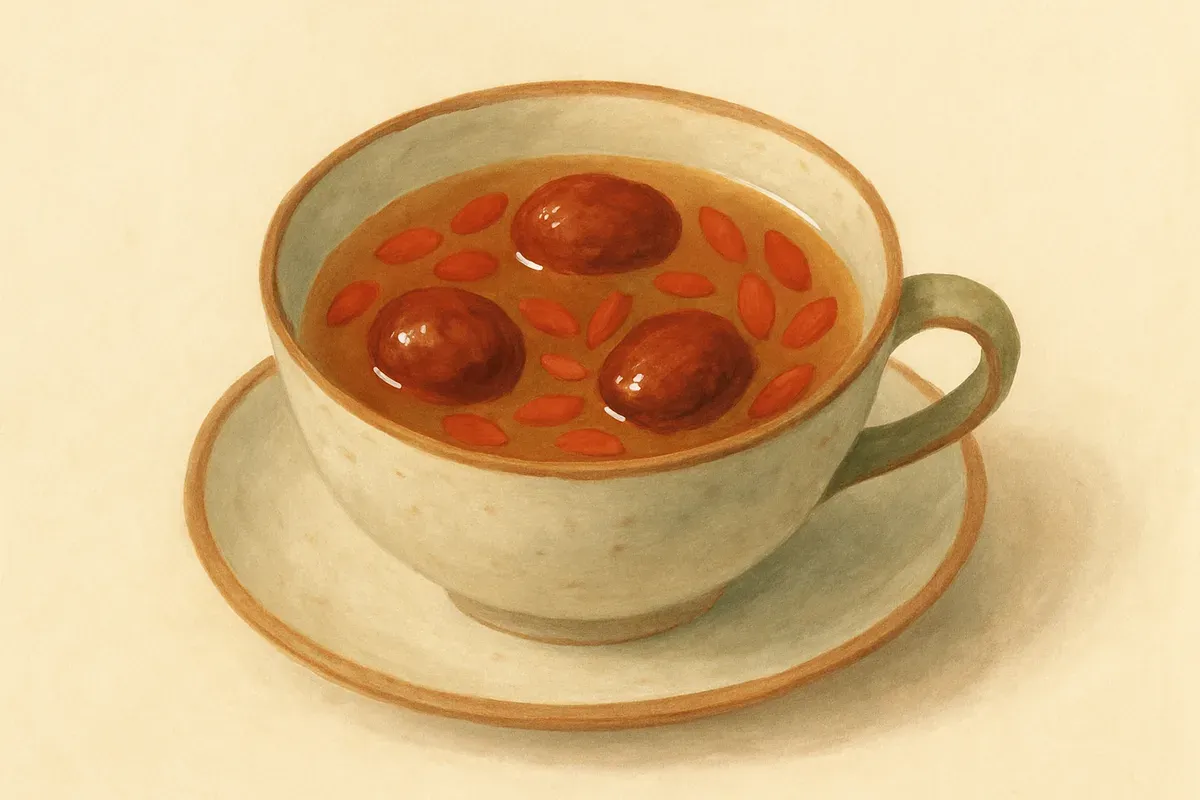
Red date and goji tea (红枣枸杞茶)
hong zao gou qi cha (红枣枸杞茶)
The everyday drink of the confinement month: warm, faintly sweet, and made in one pot. What goes in it, why, and how to keep a flask going all day.
If one thing is always within arm’s reach during the confinement month, it is a flask of red date tea. It replaces plain water in most households, it is made in a single pot, and it is sweet enough that it feels like a treat rather than a remedy.
Why this is the everyday drink
The confinement rule against cold drinks removes iced water and anything from the fridge, which leaves a practical problem: you need to drink a great deal, and warm plain water gets dull quickly. Red date tea solves it. It is warm by definition, faintly sweet, and pleasant enough to drink all day.
That matters more than it sounds. Fluid needs rise while breastfeeding, and the single most common reason women drink too little in the early weeks is that nothing appealing is within reach when they sit down to feed.
What the ingredients are for
In the traditional view each element has a job, and they are chosen to work together rather than for flavour alone:
- Red dates are the base, and are strongly associated with nourishing blood, which is exactly what birth is understood to have spent. They also carry all the sweetness the drink needs.
- Goji berries are linked to the liver and kidneys, and in the tradition the liver governs the eyes, which is why they appear so often in a month that worries about eyesight.
- Longan deepens the sweetness and is classed as warming and blood nourishing.
- Ginger warms the middle, the same reasoning that puts it in nearly every confinement dish.
Nutritionally it is a warm, hydrating drink with a little natural sugar and iron from the dates. Its real contribution is that it makes drinking enough easy.
When to drink it
Throughout. Most confinement foods belong to a particular stage of the month, but this one is a constant from the first days to the last, and plenty of families keep making it long after the month ends.
For where the individual dishes sit across the month, see how the 30 days are structured, and for the reasoning behind warm drinks generally, see should I avoid cold food and cold drinks.
The recipe
- Prep
- 5 min
- Cook
- 25 min
- Total
- 30 min
- Serves
- About 1.5 litres, a day of drinking
Why this ingredient
Red dates (红枣)
One of the most used ingredients in the confinement kitchen. In TCM red dates are classed as warm and sweet, and are said to tonify qi and nourish blood, which is exactly the deficit birth is understood to create. They are also considered to calm the spirit, and are used to harmonise other herbs in a formula, softening anything harsh alongside them.
Why this ingredient
Goji berries (枸杞子)
Associated with the liver and kidneys, the systems TCM links to deep reserves. Because the liver is said to govern the eyes, goji is the classic ingredient for eyesight, which is why it appears so often in a month that worries about straining the eyes. Added at the end of cooking so they plump rather than break down.
Ingredients
- 8 to 10 dried red dates (jujubes), halved and stones removed The base of the drink. Nourishing to blood in the TCM view, and what makes the tea sweet without sugar.
- 1 tablespoon dried goji berries (wolfberries) Added at the end so they stay plump. Associated with the liver and kidneys, and with the eyes.
- 4 to 6 dried longan fruit, shelled Optional. Deepens the sweetness and is classed as warming and blood nourishing.
- 3 thin slices fresh ginger, or 2 slices of old ginger Warms the middle. Old ginger is stronger and more warming than young.
- 1.5 litres water Filtered or tap, whichever you would normally drink.
- A small piece of rock sugar, to taste Optional and usually unnecessary, as the dates carry the sweetness.
Method
- 1 Rinse the red dates, longan and goji berries briefly in cool water to remove dust, then drain.
- 2 Halve the red dates and remove the stones. Removing them is worth the two minutes: the tea comes out sweeter and less cloying.
- 3 Put the dates, longan and ginger into a pot with 1.5 litres of water. Bring to the boil over high heat.
- 4 Reduce to a low simmer, cover, and cook for 20 minutes until the dates have softened and the liquid has turned amber.
- 5 Add the goji berries and simmer for a final 2 to 3 minutes only, so they plump rather than disintegrate.
- 6 Taste. Add a small piece of rock sugar only if you want it sweeter, and stir until dissolved.
- 7 Strain into a thermos or keep the pot warm on the lowest heat. Drink warm through the day.
Notes and substitutions
- One batch is a day of drinking. Many households make it every morning as a matter of routine, the way you would put the kettle on.
- Top the flask up with hot water as it empties rather than making a fresh pot: the dates keep giving flavour for a second round.
- Eat the softened dates and goji berries rather than discarding them. They are the most nourishing part in the traditional view.
- For a stronger, darker tea, increase to 12 dates rather than simmering longer, which can turn it bitter.
- It keeps in the fridge for 2 days, but reheat to warm before drinking rather than taking it cold.
Before you cook this
- If you take warfarin or another blood thinning medicine, check with your pharmacist before adding goji berries.
- If you have gestational or ongoing diabetes, note that red dates are high in natural sugars; ask your care team about quantities.
Common questions
Can I drink this instead of water?
That is exactly how it is used. It hydrates as well as plain water and satisfies the traditional preference for warm drinks. Fluid needs rise while breastfeeding, so a flask within reach of where you feed is one of the more useful things to set up.
Do I have to remove the date stones?
It is worth doing. Stones are held in the tradition to make the tea heaty, and practically they make it taste flatter. Halving the dates also lets the sweetness out properly, so the tea is better with less cooking.
When in the month can I drink it?
Throughout, which is unusual among confinement foods. Most dishes belong to a particular stage, but red date tea is a constant from the first days to the end of the month, and many keep drinking it afterwards.
Can I add dang gui or other herbs?
Some households do, particularly in the later stage of the month. Dang gui, or Chinese angelica, is strongly associated with blood nourishment but is potent and not suitable for everyone. Add it on the advice of a TCM practitioner rather than by default.
Is it safe while breastfeeding?
Red dates, longan, goji and ginger in culinary amounts are widely used during confinement and are ordinary foods. If you take prescription medicines, particularly blood thinners, check the goji interaction with your pharmacist.