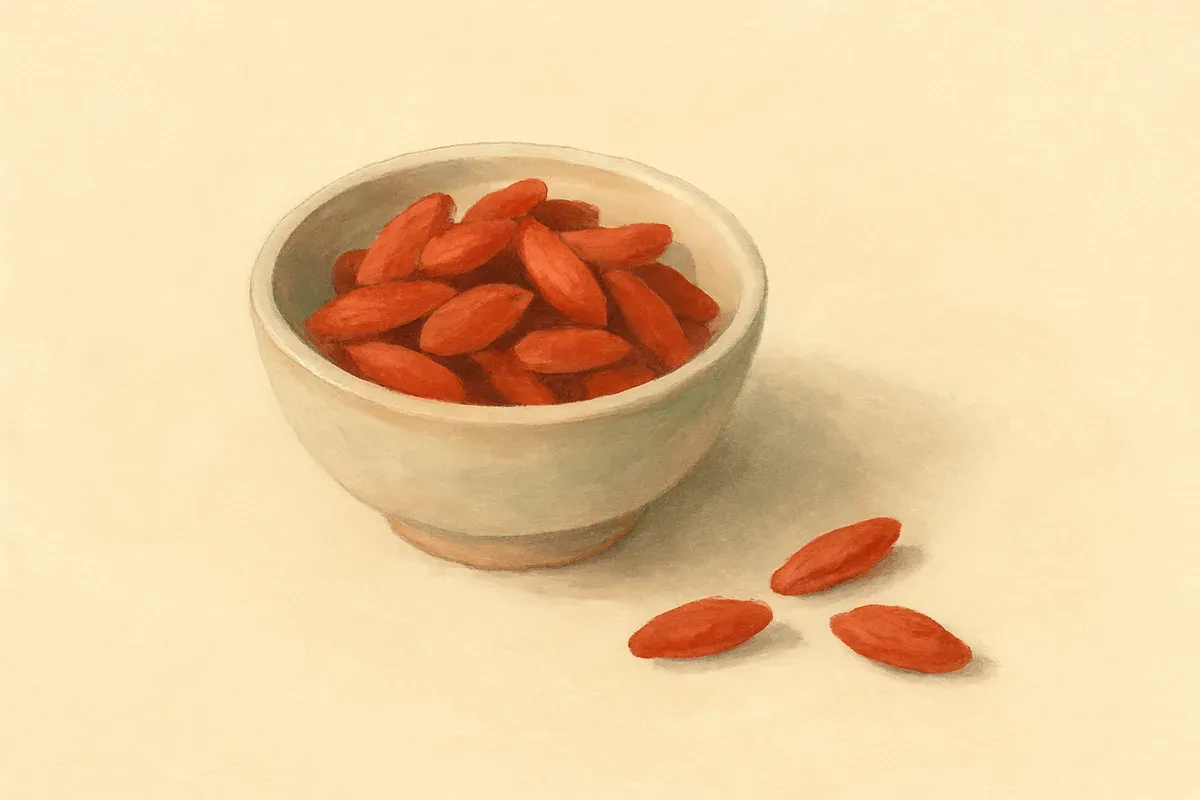
Goji berries (枸杞子): the eyes and the kidneys
gou qi zi (枸杞子)
Goji berries appear throughout confinement cooking. Why the tradition links them to the liver, kidneys and eyesight, and how to add them without overcooking.
Small, sweet and bright orange-red, goji berries turn up across the confinement kitchen, scattered over a steamed fish, simmered into a tea, dropped into a soup at the last minute. They ask almost nothing of the cook and carry a specific traditional meaning.
Why the eyes
In TCM, goji berries are associated with the liver and kidneys, two of the systems the tradition links to deep reserves. The connection that matters most during confinement runs through the liver, which in the traditional model governs the eyes. Since the month worries a good deal about straining the eyes, with its cautions around reading, screens and crying, an ingredient tied to eyesight belongs everywhere.
That is the reasoning behind goji appearing in a dish as often as it does. It is not there for flavour alone; it is there because the tradition treats it as support for exactly what the month is trying to protect. The same eye connection is why goji is a folk remedy for tired eyes well beyond the confinement context.
In the kitchen
Nutritionally they are a sweet dried fruit with a mild flavour, which is what makes them so easy to use: they slip into savoury and sweet dishes alike without taking over.
The one rule worth knowing is timing. Goji berries are soft and cook fast. Add them at the start of a long braise and they disintegrate into the liquid and turn faintly bitter. Add them in the last two or three minutes, or scatter them over a finished dish, and they plump up whole, sweet and glossy.
Buy dried berries that are still soft and pliable rather than hard and dark, with a bright colour. Keep them airtight and out of the light, where they hold for many months.
Goji berries appear in red date and goji tea, steamed fish with ginger and goji and throughout the Recipes section. The eye connection sits alongside the practices in can I use my phone, read or watch TV.
Common questions
What is the difference between goji berries and wolfberries?
They are the same thing, sold under both names. The dried orange-red berries in Chinese groceries and the goji berries in health food shops are the same fruit; the Chinese ones are usually cheaper and intended for cooking.
When do I add them to a dish?
Right at the end, in the last two to three minutes. They are soft and cook quickly, and long simmering makes them break down into the liquid and turn slightly bitter. Added late, they plump up whole and stay sweet.
Do I need to soak them first?
A quick rinse is enough for most cooking, since they soften fast in a hot dish. For eating raw, in a tea that will not be boiled, or scattered over a finished dish, a short soak in warm water plumps them nicely.
Are there any cautions?
Goji can interact with warfarin and some other blood thinning medicines. If you take one, check with your pharmacist before adding goji regularly. Otherwise, in culinary amounts they are an ordinary food.