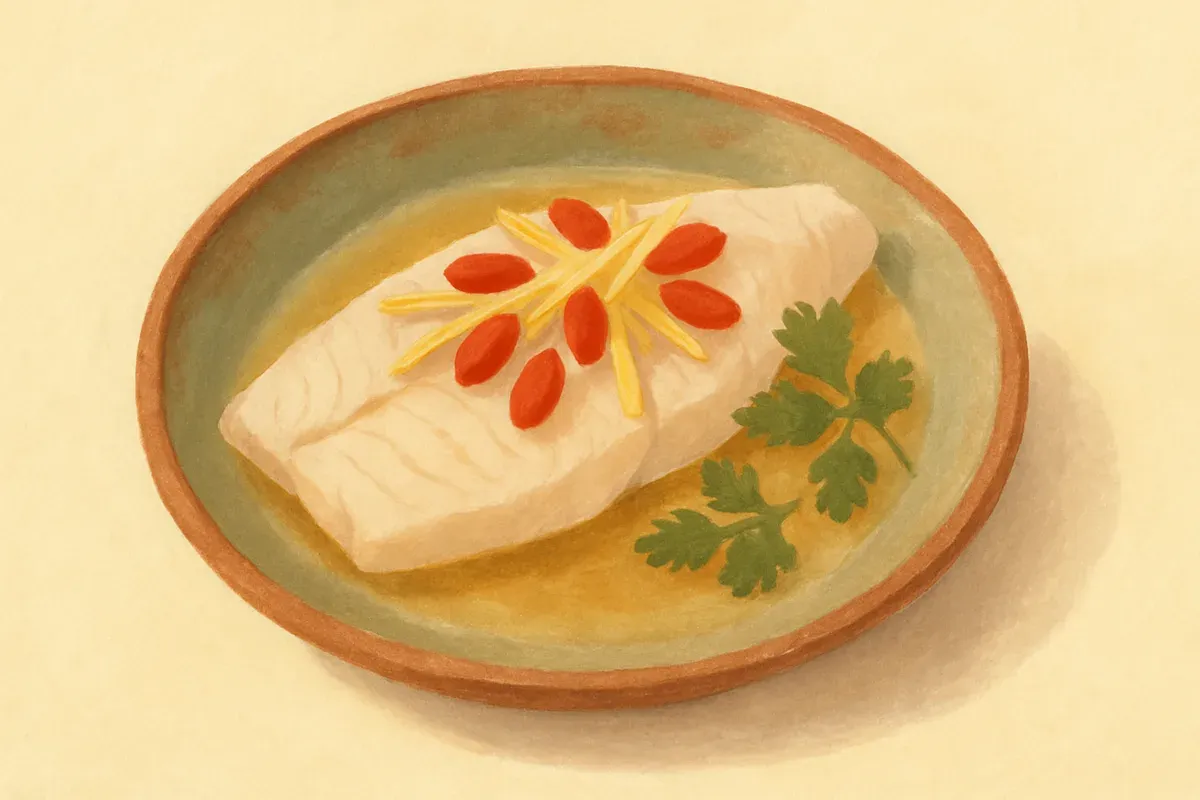
Steamed fish with ginger and goji (枸杞蒸鱼)
A light, quick confinement dish for the early weeks: white fish steamed with ginger, goji and a little rice wine, finished with hot oil and spring onion.
Most confinement dishes are long simmers. This one is not, which is exactly why it earns its place: it is on the table in under half an hour, it is light enough for the first fortnight, and it asks almost nothing of whoever is cooking.
Why fish, and why now
Fish is one of the few proteins the confinement kitchen leans on early. It is easy to digest at a point when the tradition considers the digestive system delicate, and it is protein rich at a point when tissue is repairing.
In the traditional framing fish is classed as cooler in nature than red meat, which is why it almost never appears without ginger. The pairing is not just flavour; it is the tradition balancing the dish. That is also why the ginger goes underneath as well as on top, so the steam carries it through the fish.
Getting it right
Steamed fish is unforgiving in exactly one way: time. Two minutes too long turns it from silky to chalky, and there is no recovering it. Take it out when the thickest part has just turned opaque, remembering that it keeps cooking on the hot plate.
The hot oil at the end is not optional flourish. Pouring shimmering oil over the raw spring onion and ginger blisters them and releases their aroma into the dish, and it is the difference between a home steamed fish and one that tastes like it came from a restaurant.
For where lighter dishes sit in the month, see how the 30 days are structured.
The recipe
- Prep
- 10 min
- Cook
- 15 min
- Total
- 25 min
- Serves
- 2 to 3 as part of a meal
Why this ingredient
Goji berries (枸杞子)
In TCM goji is associated with the liver and kidneys, the systems linked to deep reserves, and because the liver is said to govern the eyes it is the classic ingredient for eyesight. That makes it a natural fit for a month in which the tradition worries about straining the eyes. It is sweet and mild, so it slips into savoury dishes without dominating them.
Why this ingredient
Ginger (姜)
Ginger does two jobs here. In the traditional frame it warms the middle and offsets the cooler nature attributed to fish, which is why the two are almost always cooked together. Practically, it also removes the muddy note that white fish can carry, which is why the slices go underneath where the steam passes through them first.
Ingredients
- 1 whole white fish about 600 g, scaled and gutted, or 2 thick fillets Barramundi, snapper, ling or perch all work. Mild white fish is preferred in confinement cooking.
- 40 g ginger, half julienned and half sliced Slices go under the fish to lift it and perfume the steam; julienne goes on top.
- 1 tablespoon goji berries, rinsed Scattered over before steaming. They plump in the steam and sweeten the dish slightly.
- 2 tablespoons rice wine Removes any muddiness from the fish. Mostly evaporates during steaming.
- 2 spring onions, cut into lengths Whites under the fish, greens scattered over at the end.
- 2 tablespoons light soy sauce Poured around, not over, so the fish keeps its clean flavour.
- 2 tablespoons sesame oil or neutral oil, heated until shimmering The hot oil finish. It blisters the aromatics and is what makes the dish taste restaurant made.
Method
- 1 Pat the fish thoroughly dry, inside and out. If using a whole fish, score the thickest part twice on each side so it cooks evenly.
- 2 Lay the ginger slices and spring onion whites on a heatproof plate and set the fish on top. Lifting the fish off the plate lets steam circulate underneath.
- 3 Scatter the julienned ginger and goji berries over the fish and pour the rice wine on top.
- 4 Bring water to a hard boil in a steamer or a wok fitted with a rack. Put the plate in, cover, and steam over high heat.
- 5 Steam for 8 to 10 minutes for fillets, or 12 to 14 minutes for a whole fish, until the flesh at the thickest point turns opaque and flakes when pressed.
- 6 Carefully pour off and discard the watery liquid that has collected on the plate, which can taste flat.
- 7 Scatter over the spring onion greens. Pour the soy sauce around the edge of the plate, then heat the oil until it shimmers and pour it over the aromatics so they sizzle. Serve immediately.
Notes and substitutions
- The single most common mistake is overcooking. Fish keeps cooking on a hot plate after it leaves the steamer, so take it out a shade early.
- A fish that fits your steamer matters more than the exact species. Ask the fishmonger to scale, gut and clean it for you.
- If you have no steamer, set a small rack or two chopsticks in a wide lidded pan with a few centimetres of boiling water.
- This is a good dish for the first fortnight, when heavy braises are unappealing and cooking energy is short.
Before you cook this
- Larger predatory fish such as shark, swordfish, marlin and king mackerel carry more mercury and are generally advised against while breastfeeding. Mild white fish such as barramundi, snapper and ling are the usual choices.
- A small amount of rice wine is used and mostly steams off. Leave it out if you would rather avoid alcohol entirely.
Common questions
Can I eat fish during confinement?
Yes, and it is a staple of the confinement kitchen, particularly in the early weeks. It is easy to digest and protein rich, and the tradition pairs it with ginger to offset the cooler nature attributed to fish.
How do I know when the fish is cooked?
Press the thickest part with a chopstick or the back of a spoon. It should be opaque and flake apart cleanly. If it still looks translucent at the bone, give it another two minutes.
Why pour off the liquid before saucing?
The liquid that collects during steaming is watery and slightly muddy, and leaving it dilutes the sauce. Pouring it off and dressing the fish fresh is the standard restaurant technique.
Can I use frozen fish?
Yes, but thaw it fully in the fridge first and pat it very dry, since frozen fish releases more water. Fillets are more forgiving than a whole frozen fish.