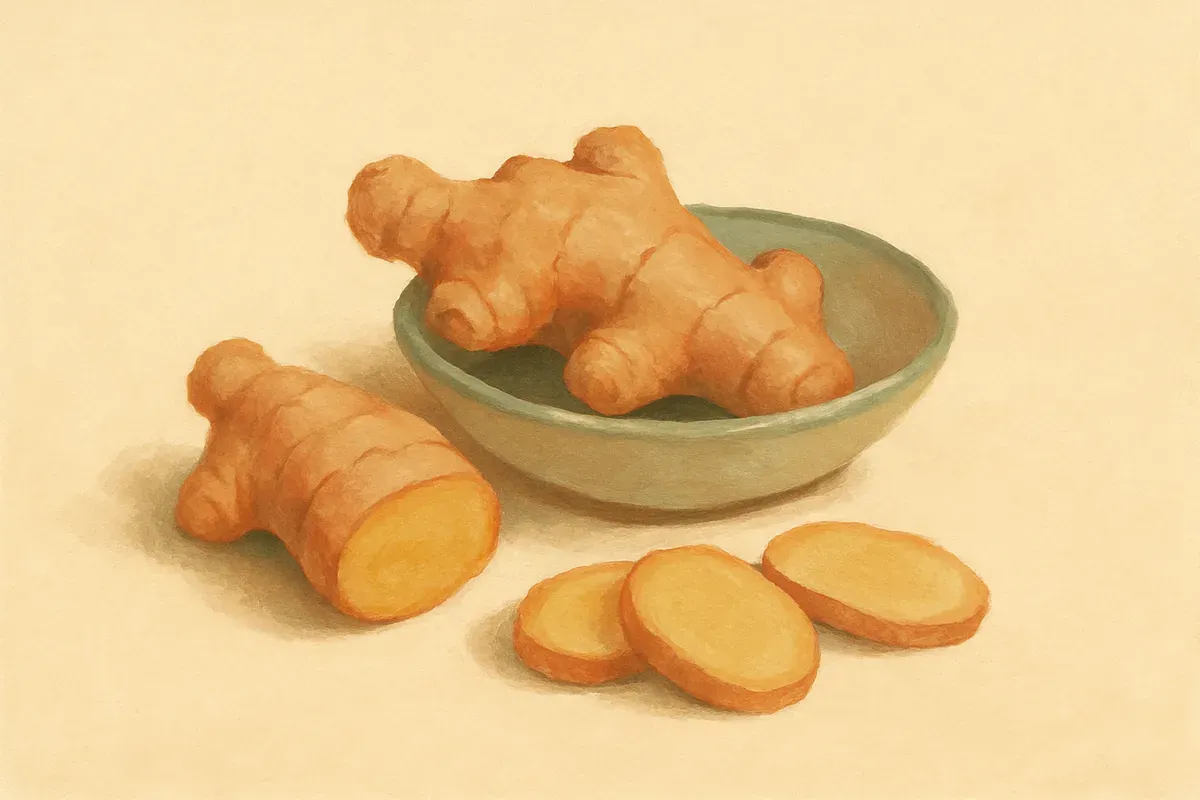
Old ginger (老姜): the warming engine of confinement
lao jiang (老姜)
Old ginger is in almost every confinement dish for one reason: warmth. What makes it different from young ginger, its role in TCM, and how to buy and use it.
If you looked in a confinement kitchen and saw only one ingredient, it would be ginger, and it would be old ginger. It goes into the soups, the braises, the stir fries, the tea and the bathwater. Understanding why explains half of confinement cooking.
Why so much ginger
The governing rule of the confinement month is warmth. In the traditional view birth leaves the body cold and depleted, and cold reaching it, through food, water or air, is the thing to guard against. Old ginger is the kitchen’s answer. In TCM it is classed as warm and pungent, and it is said to warm the middle, disperse cold, and support the Spleen, the system understood to transform food into qi and blood. A mother rebuilding both is exactly who the tradition wants it for.
That is why the quantities look startling. A dish like sesame oil chicken uses a hundred grams of ginger to a kilogram of chicken, an amount that would be eccentric in everyday cooking and is the whole point here.
Old, not young
The ginger the confinement kitchen wants is not what most supermarkets sell. Young ginger is harvested early: thin skin, a pink tinge, mild and watery. Old ginger is left to mature, and turns tough skinned, dense, fibrous and much hotter. The heat is the warmth the tradition is after, so old ginger is worth seeking out at a Chinese grocer, where it is the default.
How to use it
The move that recurs across confinement dishes is frying the ginger first, either dry in a hot pan or gently in black sesame oil, until the slices shrink and the edges colour. This is thought to draw the warmth out of the ginger and into the dish, and it deepens the flavour considerably. Most confinement recipes open with this step for a reason.
For soups and long braises the ginger goes in thickly sliced, skin on, and is strained or left aside at the end. For stir fries it is peeled and finely sliced or minced so it can be eaten.
Old ginger appears in nearly every dish in the Recipes section, and it is the hero of pork trotter in ginger and black vinegar and sesame oil chicken. For the reasoning behind the warmth rules generally, see should I avoid cold food and cold drinks.
Common questions
What is the difference between old ginger and normal ginger?
Age. Young ginger is harvested early, with thin pale skin, a pink blush and mild, juicy flesh. Old ginger is left in the ground to mature, developing tough beige skin, dense fibrous flesh and a much sharper, hotter flavour. Confinement cooking wants the old kind for its warmth.
Do I peel old ginger?
Usually not for slow braises and soups, where the skin adds flavour and is strained or left aside. Peel it for stir fries and anything eaten whole. Scrape the skin off with the edge of a spoon rather than a peeler to save the flesh.
Can I use ground ginger instead?
For flavour in a pinch, but it is a poor substitute in confinement cooking, where the quantity and the frying of fresh old ginger are central. Dried ground ginger is a different, flatter heat and cannot carry a dish like sesame oil chicken.
How do I store it?
A whole knob keeps for two to three weeks in a cool, dark, dry place, or longer wrapped in a paper towel in the fridge. Sliced ginger freezes well; freeze it flat so you can break off what you need.