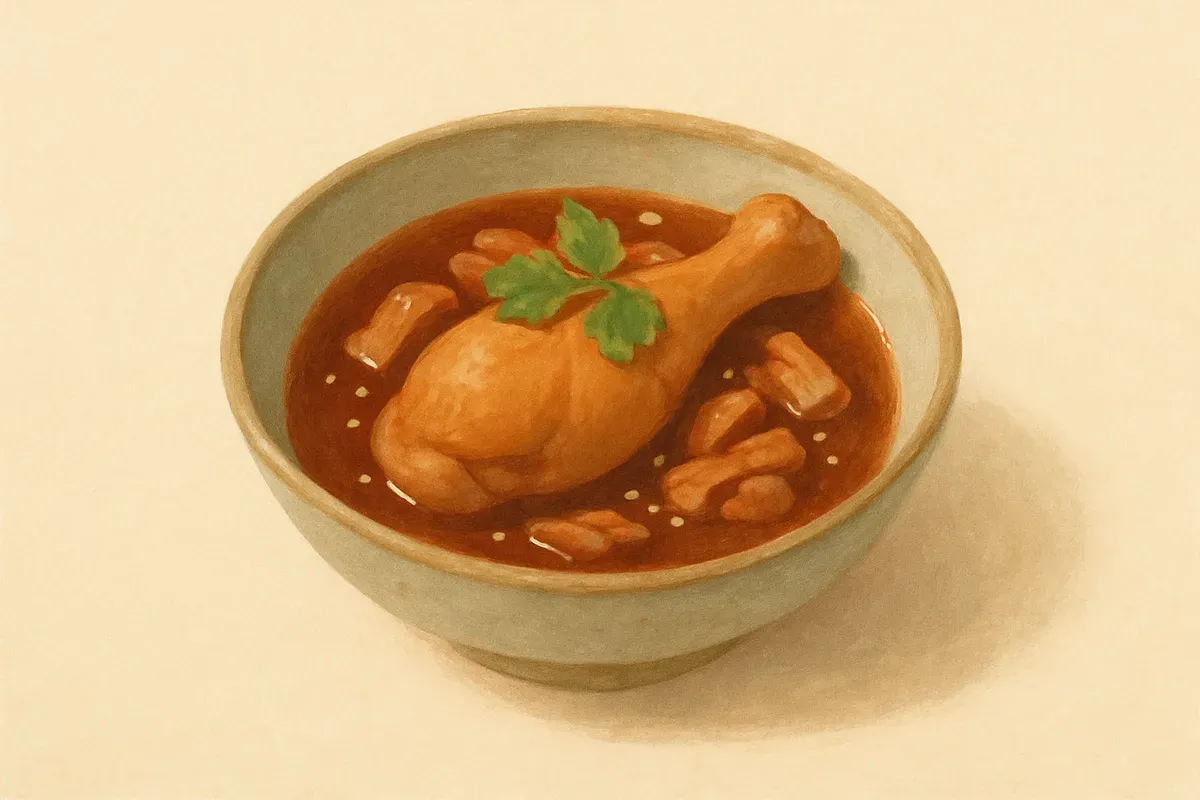
Sesame oil chicken (麻油鸡)
ma you ji (麻油鸡)
The Taiwanese confinement signature. Chicken browned in black sesame oil with a mountain of old ginger, then simmered in rice wine until deeply savoury.
If Taiwanese confinement has a signature, this is it. Chicken and a great deal of old ginger, browned in black sesame oil until the kitchen smells of nothing else, then simmered in rice wine. Many people who grew up around confinement can identify it from the next room.
Why this dish
Almost everything in it is classed as warming. Black sesame oil, old ginger and rice wine are three of the most warming ingredients in the confinement kitchen, and putting all three in one pot is deliberate. In the traditional view this is food for rebuilding, not for the first difficult days, which is why it belongs to the last stage of the month.
That staging is worth respecting even if you take the reasoning loosely, because the dish is genuinely rich. Eaten in week one, when appetite is small and digestion is delicate, most people find it too much.
The two things that decide the result
Buy real black sesame oil. Pressed from toasted black sesame, dark, thick and intensely aromatic. The pale sesame oil sold in supermarkets is a different product, and blends cut with soybean oil will not carry the dish.
Fry the ginger slowly and never let the oil smoke. Black sesame oil has a low smoke point and turns bitter fast, and that bitterness is unrecoverable. Medium heat, patience, and take it off as soon as the ginger edges curl and colour.
For where the dish sits in the month, see how the 30 days are structured, and for the reasoning behind warming foods, should I avoid cold food and cold drinks.
The recipe
- Prep
- 15 min
- Cook
- 40 min
- Total
- 55 min
- Serves
- 4 as part of a meal
Why this ingredient
Black sesame oil (黑麻油)
Pressed from toasted black sesame seeds and classed in TCM as warm and nourishing, associated with the liver and kidneys and with blood. It is the ingredient that makes this a confinement dish rather than an ordinary braise, and the tradition treats it as both food and remedy. Pale sesame oil is a different product and will not give the same result.
Why this ingredient
Old ginger (老姜)
Ginger that has been left to mature develops a much sharper, more pungent heat than the young kind. In TCM it is said to warm the middle and disperse cold, which is why confinement cooking uses it in quantities that look excessive by everyday standards. Frying it in oil first is thought to draw that warmth out.
Ingredients
- 1 kg chicken pieces on the bone, chopped into large chunks Thigh and drumstick carry the dish better than breast, which dries out over a long simmer.
- 100 g old ginger, unpeeled and sliced into thin coins A large amount by ordinary standards. Old ginger is the point of the dish, not a background note.
- 4 tablespoons black sesame oil Toasted black sesame oil, not the pale kind. It is the defining flavour and is classed as warming.
- 500 ml rice wine, or 250 ml rice wine and 250 ml water Traditionally the whole liquid is rice wine. Halving it with water gives a gentler dish.
- 6 dried shiitake mushrooms, soaked until soft Optional. Adds depth and is considered qi supporting.
- 1 tablespoon goji berries Added at the end so they stay whole.
- Salt, to taste Added at the end; the wine and mushrooms already carry savouriness.
Method
- 1 Pat the chicken pieces dry. Slice the ginger into thin coins, leaving the skin on.
- 2 Heat the black sesame oil in a heavy pot or wok over medium heat. Keep the heat moderate: black sesame oil burns easily and turns bitter.
- 3 Add the ginger and fry gently for 5 to 8 minutes, stirring, until the slices have shrunk and the edges are curling and browned. This is the flavour base and it cannot be rushed.
- 4 Turn the heat up, add the chicken, and stir fry for 5 minutes until the pieces are coloured on all sides and coated in the oil.
- 5 Add the soaked shiitake, then pour in the rice wine. Bring to the boil and let it bubble hard for 2 minutes to cook off the sharpest edge of the alcohol.
- 6 Reduce to a low simmer, cover, and cook for 25 to 30 minutes until the chicken is tender and the sauce has reduced by about a third.
- 7 Add the goji berries and salt to taste, simmer 2 minutes more, and serve hot over rice or with thin mee sua noodles.
Notes and substitutions
- Buy black sesame oil from an Asian grocer rather than a supermarket. Kadoya and Lee Kum Kee both make reliable versions; look for pure toasted sesame oil rather than a blend with soybean oil.
- Never let the sesame oil smoke. If it does, discard it and start again, because the bitterness will carry through the whole dish.
- Taiwanese households often serve this over mee sua, a fine wheat noodle, which soaks up the sauce.
- It reheats well and the flavour deepens overnight, so it is a good candidate for cooking in batches and freezing in portions.
Before you cook this
- Traditionally made with a large quantity of rice wine. Alcohol passes into breast milk, and long simmering reduces but does not reliably remove it, so many families now use half water or leave the wine out entirely.
- Strongly warming in the traditional view. Households usually hold it back until the later part of the month, and some people find it uncomfortable if they run hot or have reflux.
Common questions
When should I eat sesame oil chicken?
The third stage of the month, roughly days 21 to 30, is the traditional window. It is classed as deeply warming and tonifying, and the tradition holds that rich food given while the body is still clearing works against the process rather than with it.
Can I make it without the rice wine?
Yes. Replace the wine with water or a light chicken stock and add an extra splash of sesame oil at the end. It will be milder and less aromatic but still very good, and it removes the alcohol question entirely.
Why did my dish turn bitter?
Almost always overheated sesame oil. It has a low smoke point and turns acrid quickly. Keep the heat at medium while frying the ginger, and add the oil to a warm rather than a screaming hot pan.
Which part of the chicken is best?
Bone in thigh and drumstick. The bones add body to the sauce and the darker meat stays tender through a long simmer, whereas breast tends to go dry and stringy.