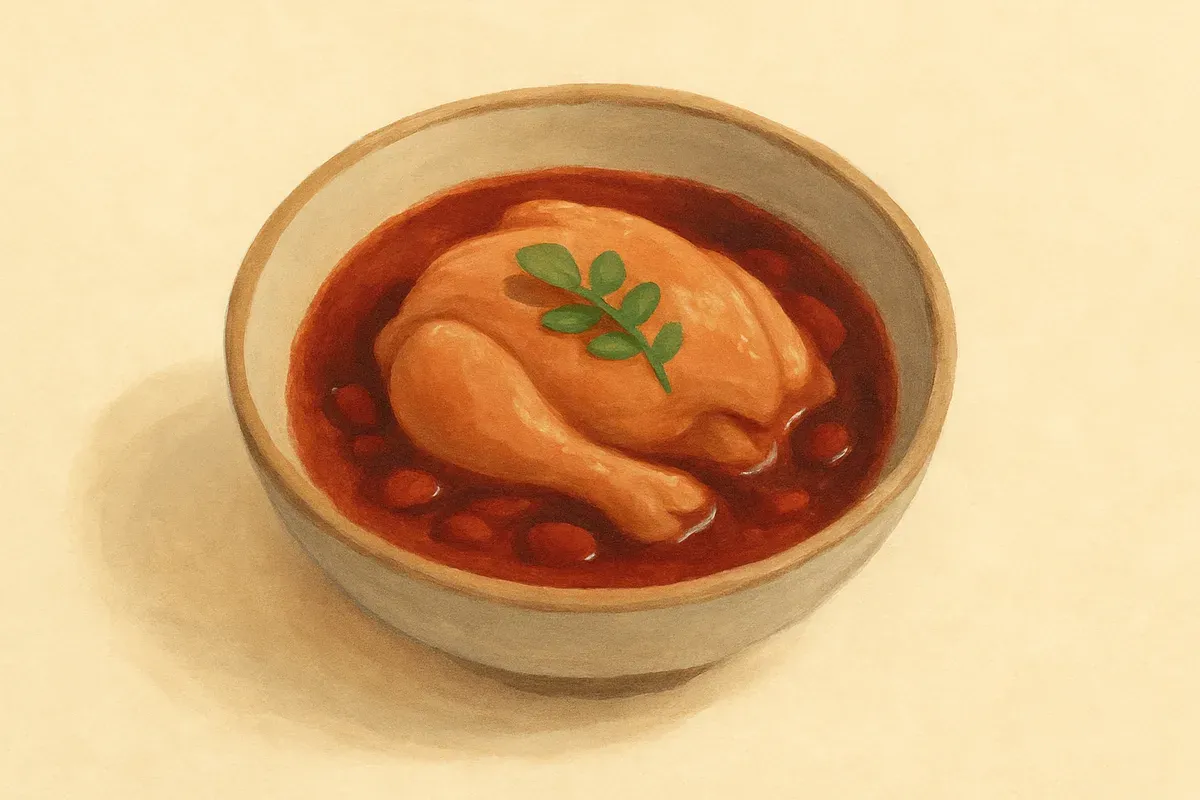
Hong zao chicken (红糟鸡)
hong zao ji (红糟鸡)
The Fuzhou confinement signature: chicken braised in red rice wine lees with old ginger, deep red, savoury and warming. A festive dish for the later weeks.
If Fuzhou confinement has a signature, it is this deep red braise. The colour and the savoury, faintly winey depth both come from one ingredient, red rice wine lees, which turns an ordinary ginger chicken into something festive.
Why this dish
Red rice wine lees, old ginger, black sesame oil and rice wine are all classed as warming, and the lees is additionally valued as blood invigorating, thought to help the body clear and rebuild in the weeks after birth. That places the dish firmly in the later part of the month rather than the delicate first days.
The ingredient that makes it
Everything turns on the hong zao. It is the soft red residue from brewing red glutinous rice wine, and it carries both the striking colour and the fermented savouriness. Without it you have a perfectly nice ginger braise, but not this dish. Buy it in a jar from a Chinese grocer and keep the rest simple.
For where a rich dish like this sits in the month, see how the 30 days are structured.
The recipe
- Prep
- 15 min
- Cook
- 35 min
- Total
- 50 min
- Serves
- 4 as part of a meal
Why this ingredient
Red rice wine lees (红糟)
The soft red residue left after brewing red glutinous rice wine, made by fermenting rice with red yeast. Fuzhou cooking treats it as both a seasoning and a tonic, and confinement tradition values it as warming and blood invigorating, thought to help the body clear and rebuild after birth. It is what makes this dish unmistakably itself; look for it in jars at a Chinese grocer.
Why this ingredient
Old ginger (老姜)
Matured ginger, far more pungent than the young kind, is said in the tradition to warm the middle and disperse cold. Frying it in the sesame oil first is thought to draw that warmth out, and it is the base almost every confinement braise is built on.
Ingredients
- 1 kg chicken pieces on the bone, chopped into large chunks Thigh and drumstick stay tender through the braise where breast dries out.
- 3 tablespoons red rice wine lees (hong zao) The heart of the dish. It gives both the deep red colour and the savoury, faintly fermented depth.
- 60 g old ginger, sliced into thin coins Old rather than young ginger, for the sharper warmth confinement cooking wants.
- 2 tablespoons black sesame oil The warming fat the ginger is fried in.
- 250 ml rice wine, or 125 ml rice wine and 125 ml water Traditionally all wine. Halving it with water gives a gentler dish.
- 1 tablespoon goji berries Stirred in at the end so they stay plump.
- 1 teaspoon sugar, and salt to taste A little sugar rounds the edge of the fermented lees.
Method
- 1 Pat the chicken dry and slice the ginger into thin coins.
- 2 Heat the black sesame oil in a heavy pot over medium heat, keeping it below smoking point, and fry the ginger for 5 minutes until the edges curl.
- 3 Add the red rice wine lees and stir for a minute until it smells fragrant and the oil turns red.
- 4 Turn up the heat, add the chicken, and stir fry for 5 minutes until every piece is coated and coloured.
- 5 Pour in the rice wine, bring to the boil and let it bubble hard for 2 minutes, then lower to a simmer, cover, and cook for 20 to 25 minutes until tender.
- 6 Stir in the goji berries, sugar and salt, simmer 2 minutes more, and serve hot over rice or mee sua.
Notes and substitutions
- Red rice wine lees (hong zao) and dried red yeast rice (hong qu) are different things; you want the soft, moist lees sold in jars.
- The colour deepens overnight, so this is a good dish to make ahead and reheat, or to freeze in portions.
- Keep the sesame oil at medium heat; like all black sesame oil it turns bitter if it smokes.
Before you cook this
- The traditional version is heavy on rice wine. Alcohol passes into breast milk and long simmering reduces but does not fully remove it, so use half water or omit the wine if you would rather avoid it.
- Considered warming and invigorating, so it is usually held back to the later weeks rather than eaten in the first days.
Common questions
What is hong zao?
Hong zao is the soft red lees left over from brewing red glutinous rice wine. It is a staple of Fuzhou cooking, used to colour and season meat and fish, and confinement tradition values it as a warming, blood invigorating ingredient.
Where do I buy red rice wine lees?
Chinese grocers stock it in jars, sometimes labelled red wine lees, hong zao or angkak paste. If you cannot find it, the dish loses its identity, so it is worth seeking out rather than substituting.
When in the month should I eat this?
The later weeks. It is a rich, warming, celebratory dish rather than a first week food, and most families serve it once appetite and digestion have settled.