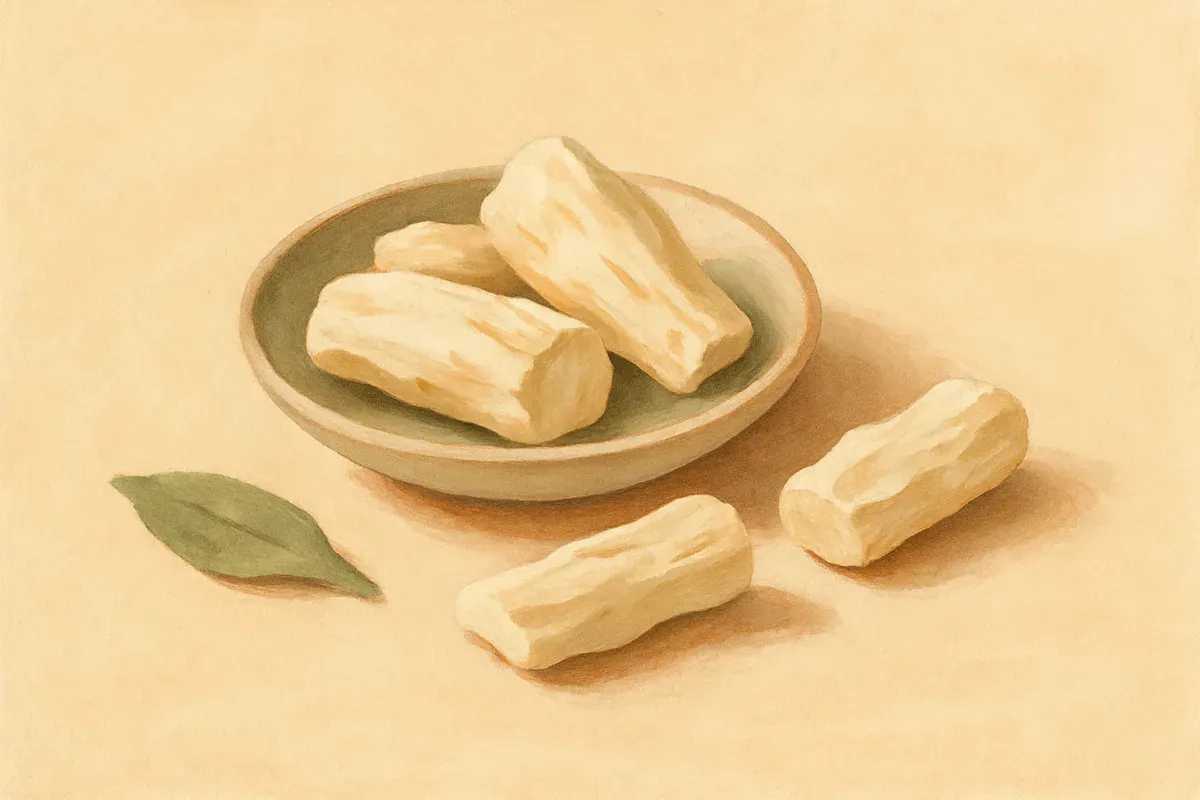
White peony root (白芍): the blood-nourishing herb
bai shao (白芍)
White peony root, bai shao, is the blood herb known as dang gui's partner in the classic postpartum formulas. What it does, and why it is used with care.
Some confinement ingredients you can toss into a pot on instinct. White peony root is not quite one of them. It is a herb with a specific job, almost always done in company, and it rewards a little understanding rather than a free hand.
Why blood, and why pain
In TCM, white peony is used to nourish blood and to soften the liver, and it has a quality the blood herbs do not all share: it is said to relax and ease cramping. After birth, when the tradition is focused on rebuilding the blood that labour has spent, and when afterpains are common as the uterus contracts, a herb that does both at once earns its place. The blood side of its work is the same concern that runs through dang gui and the whole framework of qi, blood, cold and wind.
A formula herb, not a solo ingredient
White peony is best known as one of the four herbs in the classic blood-tonic formula, where it sits beside dang gui. That is the key to understanding it: it is built to work in a balanced group, each herb tempering and completing the others, rather than to carry a dish alone the way red dates or ginger can. Used out of that context, it is only doing half its job.
Cool by nature, warmed by its company
White peony is slightly cooling, which in a warming month might seem out of place. The answer is the formula again: its cool is balanced by warming companions, so the whole stays in keeping with the tradition’s care around warmth. It is one more reason the herb belongs in a considered blend rather than a solo experiment.
Use it with guidance
More than most ingredients on this site, white peony is one to approach through a qualified Chinese medicine practitioner, who can match the formula to your constitution and to where you are in recovery. That is especially worth doing postpartum and while breastfeeding, when what suits one mother may not suit another. Treated that way, it is a quietly important part of the tradition’s approach to rebuilding after birth.
Sources
- The Zuo Yuezi Guide
- Zuo Yuezi: An American Mother's Guide to Chinese Postpartum Recovery (Guang Ming Whitley)
Common questions
What is white peony root used for after birth?
It is used to nourish blood and to ease cramping, including the afterpains that come as the uterus contracts back down. Its classic home is the foundational blood-tonic formula, where it works alongside dang gui rather than on its own.
Is it the same as the peony flowers in a garden?
No. Bai shao is the dried root of a particular peony grown as a medicinal plant, not the ornamental garden flower. It is sold as pale, hard, curled slices in Chinese herb shops.
Can I add it to soups myself?
It is really a formula herb rather than a standalone ingredient, and formulas are meant to be matched to the person taking them. Because the balance matters, and doubly so while recovering and breastfeeding, white peony is best used with a qualified Chinese medicine practitioner rather than added on a whim.