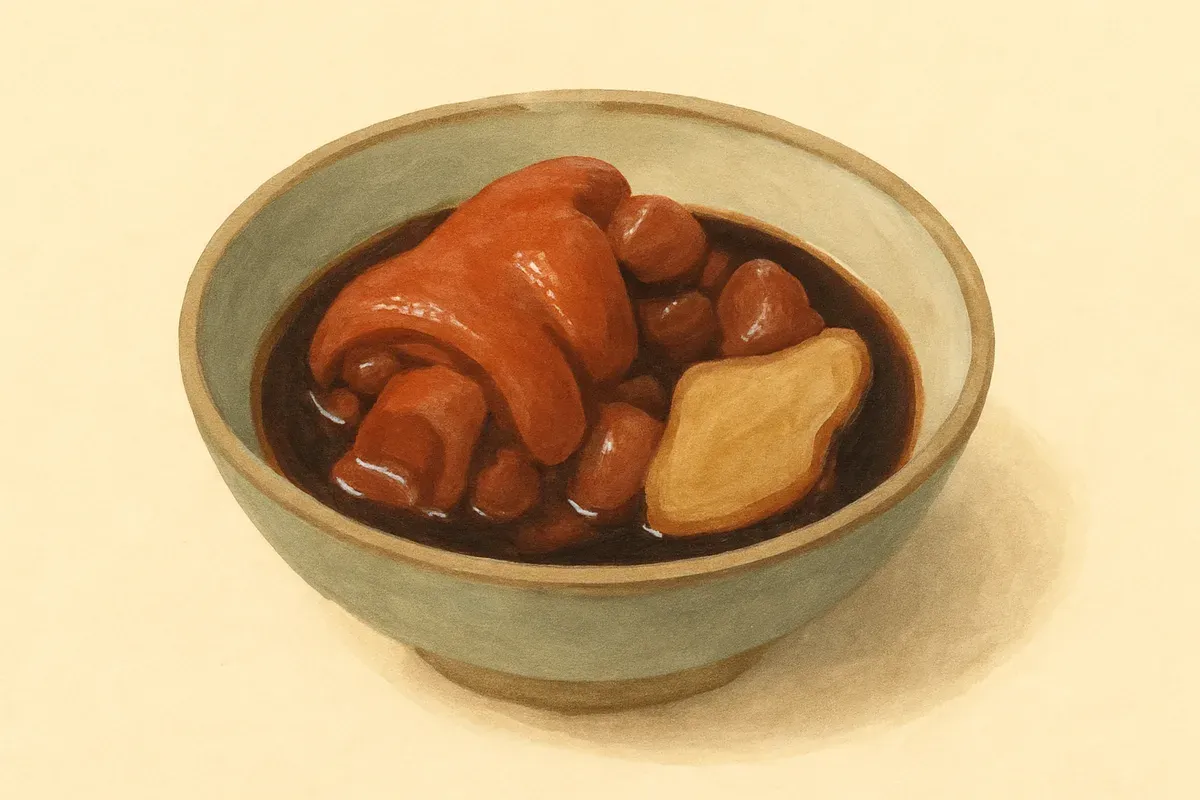
Pork trotter in ginger and black vinegar (猪脚姜)
zhu jiao jiang (猪脚姜)
The Cantonese confinement classic. Trotters simmered for hours in sweetened black vinegar and old ginger, and the one dish worth buying the right vinegar for.
If Cantonese confinement has one emblematic dish, this is it. Pork trotters, old ginger and sweetened black vinegar, simmered for hours until the skin is soft and the sauce is dark and syrupy. Households make it in enormous batches, often before the baby arrives, and the smell of it is what many people remember about the month decades later.
Why this dish
In the traditional view it does several things at once. Old ginger and vinegar are both classed as strongly warming, and warmth is the governing principle of confinement. The trotters are valued for their collagen and richness, understood as rebuilding what birth has spent, and the vinegar is held to help the body draw minerals from the bones during the long simmer.
It is also the clearest example of confinement food being staged. This is a stage three dish, for the last third of the month. Given in the first days, when the tradition says the body is still clearing, rich tonifying food is considered counterproductive rather than helpful. If you want the reasoning in full, see how the 30 days are structured.
The one thing worth getting right
Buy sweetened black vinegar. This is the single decision that determines whether the dish works.
Sweetened black vinegar, of which Pat Chun is the most widely used, is made specifically for this dish and is already balanced. The unsweetened black vinegars, Chinkiang, Pearl River Bridge, Koon Chun, are excellent for dipping dumplings and useless as a base here: they are sharply sour, and correcting them takes so much sugar that the result tastes flat and syrupy rather than rounded.
Most families use a large bottle of the sweetened kind with a splash of the unsweetened added back for edge. That is what the recipe below does.
The two steps that matter
Dry fry the ginger. No oil, medium heat, until the slices smell sharp and colour slightly at the edges. This drives off water and concentrates the ginger rather than leaving it watery in the pot.
Cook the vinegar and ginger alone first, for a full 90 minutes, before the meat goes anywhere near it. This is the step people skip and the reason home versions taste harsh. The vinegar needs that time to mellow from sour to round, and the ginger needs it to soften.
One practical warning: never cook this in aluminium or bare cast iron. The vinegar reacts with the metal. Clay, enamelled cast iron or stainless steel only.
For the wider confinement kitchen and where each dish belongs across the month, see the Recipes section, and for the reasoning behind warming foods generally, should I avoid cold food and cold drinks.
The recipe
- Prep
- 30 min
- Cook
- 3 hr 30 min
- Total
- 4 hr
- Serves
- 4 to 6 as part of a meal
Why this ingredient
Old ginger (老姜)
The warming engine of the confinement kitchen. Old ginger is more pungent and considerably more warming than young ginger, and in TCM it is said to warm the middle, disperse cold and support the Spleen, the system understood to turn food into qi and blood. Since cold reaching a depleted body is the central worry of the month, ginger appears in almost every confinement dish.
Why this ingredient
Sweetened black vinegar (甜醋)
Classed as warm and sour, and traditionally said to move blood and disperse stasis, which is why it belongs to a dish eaten after the body has finished clearing. It has a practical role too: the long acidic simmer draws minerals from the trotter bones into the sauce, and it preserves the dish, which is why families could make it in bulk before refrigeration.
Ingredients
- 1 kg pork trotters, chopped into pieces by the butcher Ask for the front trotters, which have more skin and tendon. Collagen rich and prized in the tradition for rebuilding after birth.
- 300 g old ginger, peeled and sliced into thick rounds Old ginger, not young: it is far more pungent and is classed as strongly warming, which is the whole point of the dish.
- 1.5 litres sweetened black vinegar (Pat Chun or similar) The base of the braise. Sweetened varieties are made for this dish and need no sugar added.
- 150 ml unsweetened black vinegar (Chinkiang or Koon Chun) Sharpens the sweetened vinegar so the dish does not turn cloying. Adjust to taste.
- 6 to 8 eggs, hard boiled and peeled Optional and very traditional. They absorb the sauce and are often the best part.
- 2 tablespoons Shaoxing rice wine, for blanching Used in the blanching water to draw out any gamey smell from the trotters.
- 1 teaspoon salt, to taste Added at the very end, once the sauce has reduced.
Method
- 1 Ask your butcher to chop the trotters into 4 to 5 cm pieces. Check the skin for any remaining hairs and scrape them off with a knife under running water.
- 2 Blanch the trotters in a large pot of boiling water with the rice wine for 5 minutes. Drain, rinse under cold water to remove any scum, and pat thoroughly dry.
- 3 Dry fry the ginger in a wide, heavy pot over medium heat with no oil, turning occasionally, for 8 to 10 minutes until the slices smell sharp and the edges are lightly browned. This drives off moisture and deepens the flavour.
- 4 Pour in both vinegars and bring to the boil. Reduce to a low simmer, cover, and cook the ginger in the vinegar alone for 90 minutes. Do not skip this: the vinegar mellows and the ginger softens before the meat is introduced.
- 5 Add the trotters and stir to coat. Bring back to the boil, then reduce to the lowest simmer, cover, and cook for 1.5 to 2 hours until the skin is soft and the meat pulls easily from the bone.
- 6 Add the peeled boiled eggs in the last 30 minutes so they take on colour and flavour without becoming rubbery.
- 7 Uncover, add the salt, and simmer for a final 10 to 15 minutes until the sauce has thickened and coats the back of a spoon. Taste and add a splash more unsweetened vinegar if it is too sweet.
Notes and substitutions
- Vinegar matters more than anything else here. Pat Chun sweetened black vinegar is the one most families use, because unsweetened brands such as Pearl River Bridge or Koon Chun are very sharp and need a great deal of sugar to correct.
- Use a clay pot, enamelled cast iron or stainless steel. Never aluminium or bare cast iron: the vinegar reacts with the metal and will taint the dish.
- In a pressure cooker, cook the ginger and vinegar for 30 minutes, then the trotters for about 1 hour.
- This is traditionally made in a big batch before the birth, and it genuinely improves for three to four days as the flavour penetrates. Keep it refrigerated and reheat portions thoroughly.
- The sauce is precious. Serve it over rice or use it to braise eggs for the days afterwards.
Before you cook this
- The dish is acidic and very rich. If you have reflux, which is common in the early weeks, take it in small portions or leave it until later in the month.
- A small amount of rice wine is used in the blanching water and mostly discarded. If you would rather avoid alcohol entirely while breastfeeding, blanch with a few extra ginger slices instead.
Common questions
When in the month should I eat this?
The third stage, days 21 to 30, is the traditional window. It is classed as strongly warming and deeply tonifying, and the tradition holds that rich tonifying food given while the body is still clearing is counterproductive. Many families begin it around day 12 to 14 at the earliest.
Which vinegar should I buy?
A sweetened black vinegar made for this dish, of which Pat Chun is the best known. Unsweetened black vinegars such as Chinkiang, Pearl River Bridge or Koon Chun are made for dipping and dressing, and using them alone means adding a lot of sugar and still missing the rounded flavour.
Why cook the ginger and vinegar before adding the meat?
Two reasons. The long simmer mellows the vinegar from sharp to rounded, and it softens the ginger so it becomes edible rather than fibrous. Adding the trotters at the start gives a harsher sauce and overcooked meat.
Can I make it without the trotters?
Yes. Many households make a ginger vinegar and egg version with no meat at all, using the same method and simmering the eggs in the sauce. Pork ribs are another common substitution if trotters are hard to find or the texture is not for you.
How long does it keep?
Four to five days refrigerated, and it improves over the first few. It also freezes well in portions. The vinegar acts as a preservative, which is part of why the dish was traditionally made in bulk before the birth.