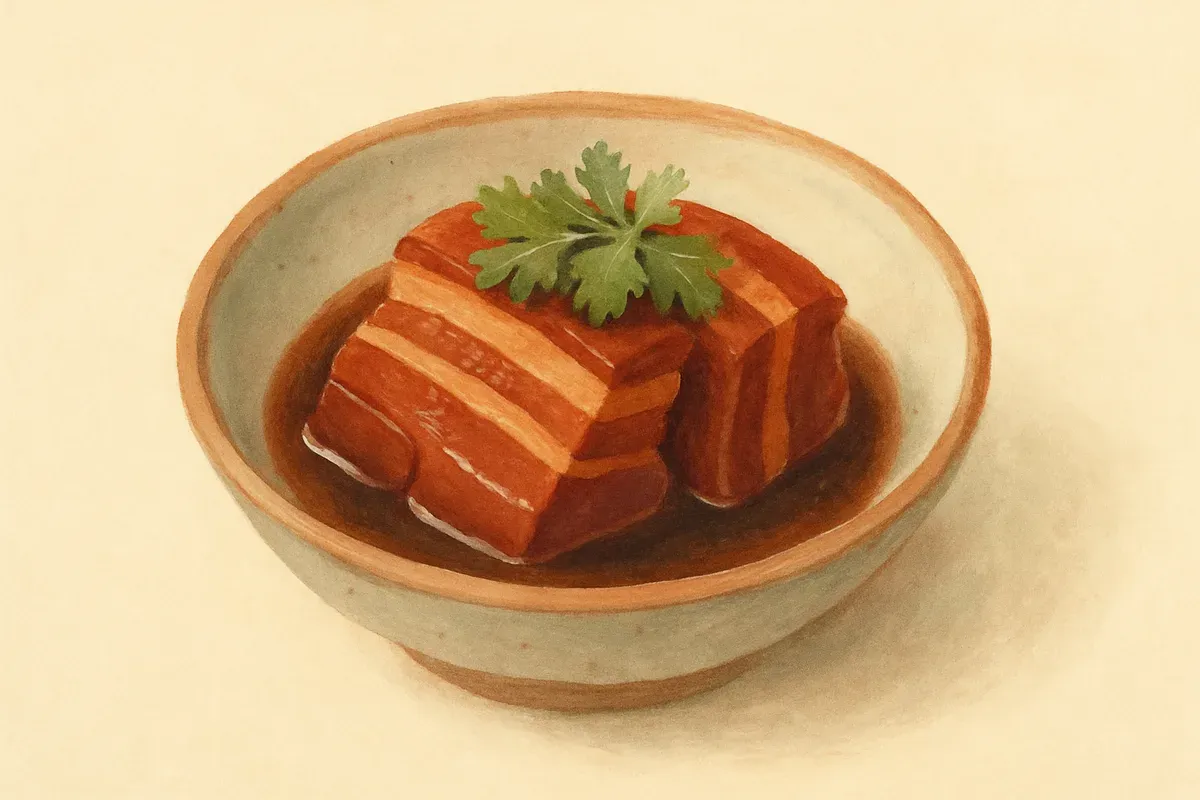
Five-spice braised pork belly (五香焖五花肉)
wu xiang men wu hua rou (五香焖五花肉)
Pork belly slow-braised with old ginger, star anise and dark soy until meltingly tender. A rich, warming dish for the later weeks of the month.
Not every confinement dish is gentle broth and steamed egg. The later weeks make room for richer, restorative food, and a slow braise of pork belly with ginger and warming spice is a classic of that stage.
Why this dish
Pork belly is energy dense and satisfying, the kind of food the tradition treats as building strength once the body has moved past the delicate first days. What makes it confinement food rather than an everyday red braise is the company it keeps: a generous amount of old ginger and warming spices like star anise, both to lift it into the warming palette and to cut the richness.
Low and slow
The whole dish rests on a gentle braise. Keep the heat to a bare simmer so the fat turns silky before the lean can toughen, then reduce the sauce at the end until it glazes the meat. It is forgiving, improves overnight, and freezes well.
For where a rich dish sits in the month, see how the 30 days are structured.
The recipe
- Prep
- 15 min
- Cook
- 1 hr 15 min
- Total
- 1 hr 30 min
- Serves
- 4 as part of a meal
Why this ingredient
Star anise (八角)
Star anise is one of the warming spices at the heart of Chinese braising, and in the tradition warmth is exactly what confinement cooking is looking for. It gives this dish its rounded, liquorice-sweet depth and, with the old ginger, is what pulls a plain red braise towards the warming character the month favours.
Why this ingredient
Old ginger (老姜)
Beyond its warmth, old ginger does something practical in a rich dish like this: it cuts the heaviness of the pork belly and keeps it from sitting too heavily. The tradition reaches for it in almost every braise, both as a warming ingredient and to keep fatty meat from feeling cloying.
Ingredients
- 600 g pork belly, cut into large 3 cm pieces Skin on, with a good ratio of fat to lean, which is what turns silky over a long braise.
- 40 g old ginger, sliced into thick coins A generous amount, both for warmth and to cut the richness of the belly.
- 2 star anise and a small piece of cinnamon bark Warming spices that give the five spice character. Whole, so they can be lifted out.
- 1 tablespoon dark soy and 2 tablespoons light soy Dark soy for colour, light soy for seasoning.
- 1 tablespoon rock sugar Rounds the braise and helps it glaze. A little sweetness balances the soy.
- 400 ml water, and a splash of rice wine (optional) Enough to come halfway up the meat; it reduces to a glossy sauce.
Method
- 1 Blanch the pork belly in boiling water for 3 minutes, then drain and rinse. This removes surface scum and gives a cleaner braise.
- 2 In a heavy pot, fry the ginger and rock sugar in a little oil over medium heat until the sugar melts and turns amber.
- 3 Add the pork belly and turn to coat and colour it in the caramel for a few minutes.
- 4 Add the star anise, cinnamon, both soy sauces, the optional rice wine and the water. Bring to the boil.
- 5 Lower to a bare simmer, cover, and braise for 60 to 75 minutes, until the belly is tender and the fat is soft. Turn the pieces once or twice so they colour evenly.
- 6 Uncover, raise the heat and reduce the sauce until it is glossy and coats the meat. Lift out the spices and serve hot over rice.
Notes and substitutions
- The flavour deepens overnight, so it is one of the best dishes to make a day ahead. Skim the set fat from the top before reheating if you want it lighter.
- A few soft boiled eggs or squares of firm tofu braised in the sauce for the last 20 minutes stretch the dish.
- Keep the simmer very gentle; a hard boil toughens the lean before the fat softens.
Before you cook this
- A rich, fatty dish. The tradition holds it back to the later weeks and serves it in modest portions alongside greens and rice rather than on its own.
Common questions
When should I eat pork belly during confinement?
In the later weeks. It is rich and energy dense, which the tradition considers restorative once the body has moved past the delicate early days, but too heavy for the first week when appetite and digestion are still settling.
Can I make it less oily?
Yes. Braise it a day ahead, chill it, and lift off the layer of fat that sets on top before reheating. Serving it with plenty of greens and rice also balances the richness.
What cut can I use instead of belly?
Pork shoulder or a piece of leg with some fat will braise well too, and gives a leaner result. They need a similar cooking time to turn tender.