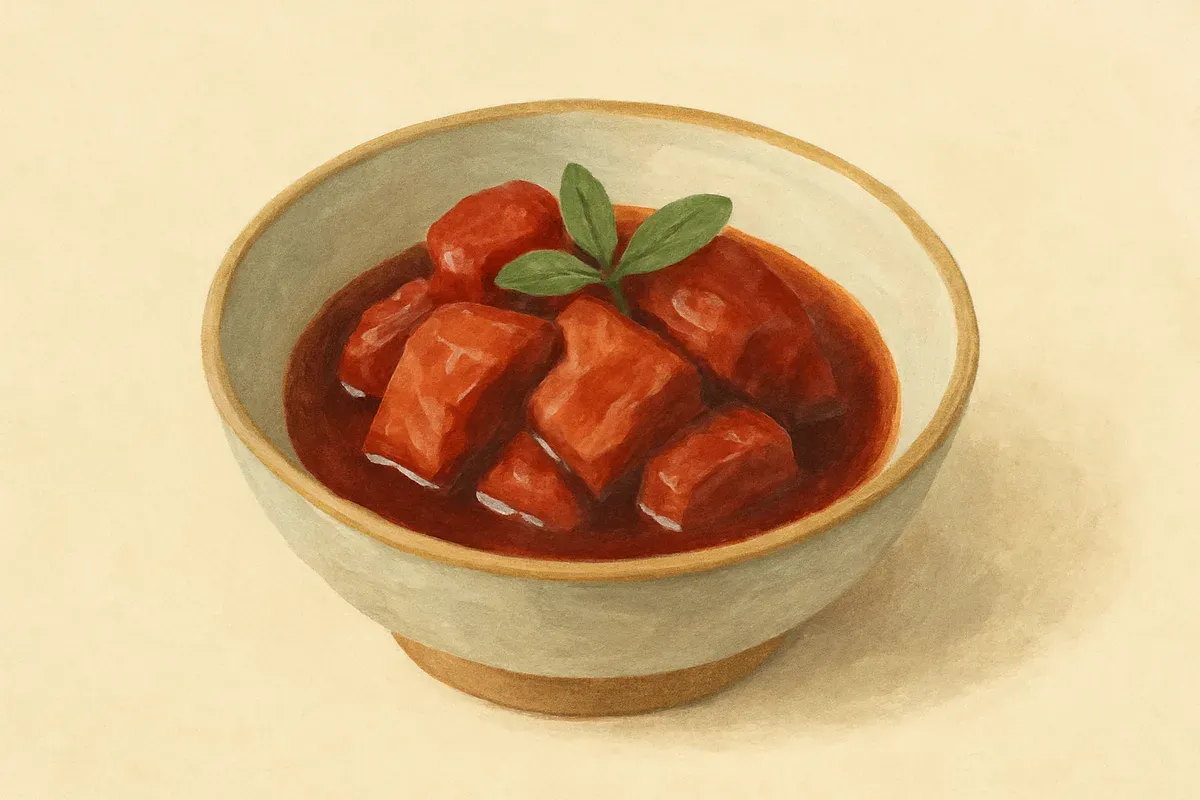
Red rice wine pork (红糟肉)
hong zao rou (红糟肉)
Pork belly braised in red rice wine lees with old ginger, deep red and savoury. The Fuzhou companion to hong zao chicken, for the rebuilding weeks.
Where Fuzhou confinement has hong zao chicken, it also has hong zao pork: the same deep red braise, built on red rice wine lees, but with melting pork belly in place of chicken. It is the richer of the pair, and a dish for the rebuilding weeks.
Why this dish
The red rice wine lees carries both the striking colour and the savoury, faintly winey depth, and the tradition values it as warming and blood invigorating. With old ginger, black sesame oil and rice wine alongside, the whole dish is firmly in the warming camp, which is why it belongs to the later part of the month rather than the delicate first days.
Make it ahead
Like most rich braises, it is better the next day once the colour and flavour have settled into the pork. Make it in advance if you can, and skim the set fat from the top before reheating for a lighter result.
For where a rich dish sits in the month, see how the 30 days are structured.
The recipe
- Prep
- 15 min
- Cook
- 1 hr
- Total
- 1 hr 15 min
- Serves
- 4 as part of a meal
Why this ingredient
Red rice wine lees (红糟)
The soft red residue left from brewing red glutinous rice wine, made by fermenting rice with red yeast. Fuzhou cooking treats it as both seasoning and tonic, and confinement tradition values it as warming and blood invigorating, thought to help the body clear and rebuild after birth. It is what makes the dish unmistakably itself; find it in jars at a Chinese grocer.
Why this ingredient
Old ginger (老姜)
Old ginger both warms the dish and stops the fatty pork from sitting heavily. The tradition reaches for it in almost every braise, and frying it in the sesame oil first is thought to draw out its warmth.
Ingredients
- 500 g pork belly, cut into 3 cm pieces Skin on, with a good fat to lean ratio, which turns silky over the braise.
- 3 tablespoons red rice wine lees (hong zao) The heart of the dish, giving both the red colour and the fermented savoury depth.
- 40 g old ginger, sliced For warmth, and to cut the richness of the belly.
- 2 tablespoons black sesame oil The warming fat the ginger is fried in.
- 200 ml rice wine, or half wine and half water Traditionally all wine. Halving it with water gives a gentler dish.
- 1 teaspoon rock sugar, and salt to taste A little sugar rounds the edge of the fermented lees.
Method
- 1 Warm the black sesame oil in a heavy pot over low heat and fry the ginger until fragrant.
- 2 Turn up the heat, add the pork and brown the pieces on all sides.
- 3 Stir in the red rice wine lees and cook for a minute, then add the rice wine, water, rock sugar and a little salt.
- 4 Bring to a simmer, cover and braise gently for about 50 minutes, until the pork is tender.
- 5 Uncover, raise the heat and reduce the sauce until glossy, then taste and adjust the salt.
Notes and substitutions
- Red rice wine lees (hong zao) is the soft, moist lees sold in jars, not the dry red yeast rice (hong qu).
- The colour and flavour deepen overnight, so this is a good dish to make ahead and reheat.
- Keep the sesame oil below smoking point; it turns bitter if it burns.
Before you cook this
- Heavy on rice wine in the traditional version. Alcohol passes into breast milk and long simmering reduces but does not fully remove it, so use half water or leave the wine out if you prefer.
- Rich and warming, so it is usually held to the later weeks and eaten in modest portions.
Common questions
How is this different from hong zao chicken?
They share the same defining ingredient, red rice wine lees, and the same Fuzhou roots, but one uses pork belly and the other chicken. The pork is richer and more melting; the chicken is lighter. Many families make both across the month.
Where do I buy red rice wine lees?
Chinese grocers stock it in jars, sometimes labelled red wine lees, hong zao or angkak paste. Without it the dish loses its identity, so it is worth seeking out rather than substituting.