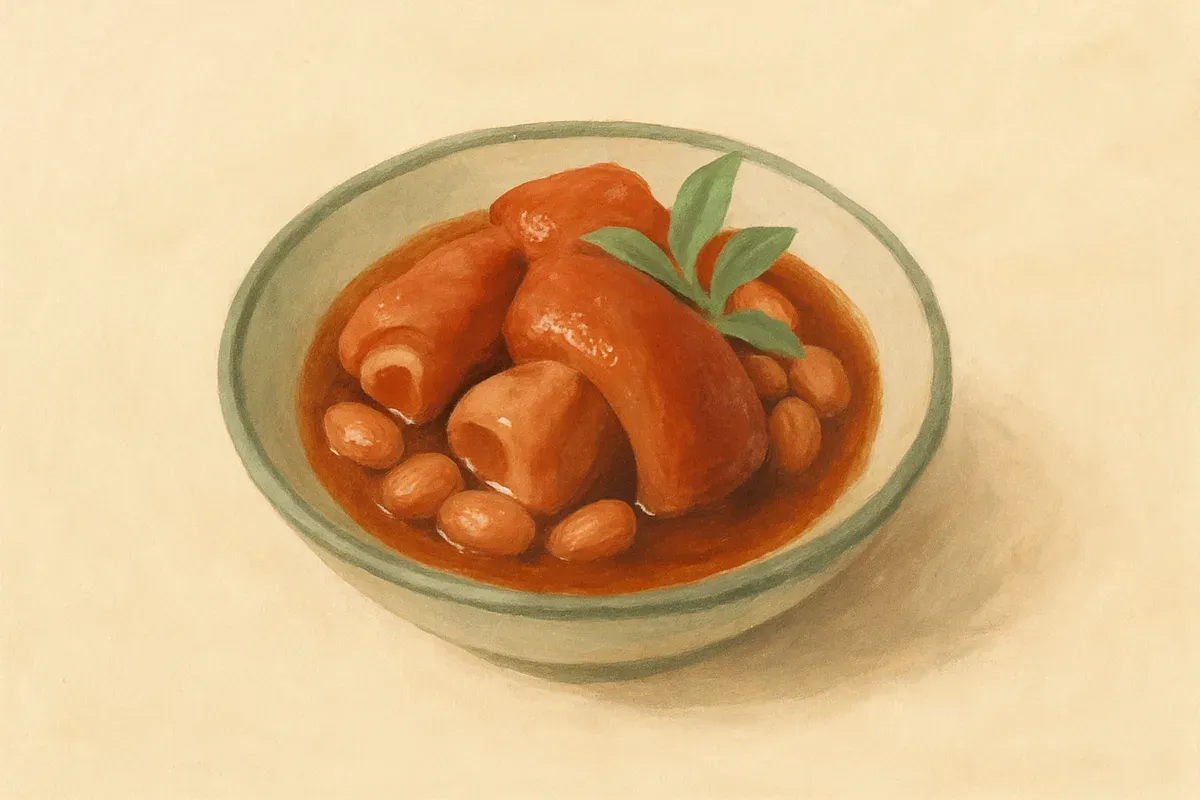
Peanut and pork trotter braise (花生炆猪手)
hua sheng men zhu shou (花生炆猪手)
Pork trotter braised slow with peanuts until sticky and tender. A traditional dish for milk supply, distinct from the vinegar trotter of the first days.
Pork trotter turns up twice in confinement cooking, in two forms that could hardly be more different. The sweet vinegar version belongs to the first days; this savoury braise, with peanuts turned soft and creamy, belongs to the weeks after.
Why this dish
Trotter is among the foods most closely tied in the tradition to milk supply, and peanuts are its usual partner in that role. The honest modern picture is that milk depends mostly on frequent feeding and on the mother being well nourished, so a dish like this is best understood as one nourishing, comforting part of that picture rather than a cure. Either way, it is a genuinely good braise.
Give it time
Trotter needs a long, slow braise to turn tender and sticky, and the peanuts need that time to soften. Make it a day ahead if you can: it improves overnight, and chilling lets you lift off the fat for a lighter dish.
For more on eating for milk supply, see our food and recipes section.
The recipe
- Prep
- 20 min
- Cook
- 1 hr 30 min
- Total
- 1 hr 50 min
- Serves
- 4 as part of a meal
Why this ingredient
Pork trotter (猪手)
Pork trotter is one of the foods most strongly linked in the tradition to supporting milk supply, and its richness in collagen is the plain reason behind that association. It appears in confinement cooking in two very different guises: the sweet black vinegar version of the first days, and savoury braises like this one, eaten through the weeks that follow.
Why this ingredient
Peanuts (花生)
Peanuts are a traditional partner to trotter in lactation dishes, valued as nourishing and, like the trotter, associated with supporting milk. Soaked and braised long, they turn soft and creamy and thicken the sauce, so they are as much a part of the texture of the dish as a tonic addition.
Ingredients
- 1 pork trotter (about 700 g), chopped into pieces Ask the butcher to chop it, ideally the front trotter, which has more meat.
- 150 g raw peanuts, soaked for a few hours Soaking softens them so they turn creamy over the braise.
- 40 g old ginger, sliced For warmth and to lift the richness of the trotter.
- 2 tablespoons oyster sauce and 1 tablespoon light soy The savoury base of the braise.
- 1 teaspoon dark soy and 1 tablespoon rock sugar Dark soy for colour, rock sugar to round and glaze.
- 600 ml water, and a splash of rice wine (optional) Enough to cover; it reduces to a sticky sauce.
Method
- 1 Blanch the trotter pieces in boiling water for 5 minutes to remove scum, then drain and rinse well.
- 2 In a heavy pot, fry the ginger and rock sugar in a little oil until the sugar melts and turns amber.
- 3 Add the trotter and turn to coat and colour, then add the soaked peanuts, oyster sauce, both soy sauces and the optional rice wine.
- 4 Pour in the water to just cover, bring to the boil, then lower to a gentle simmer and cover.
- 5 Braise for 80 to 90 minutes, until the trotter is very tender and the skin is soft and sticky, topping up with a little hot water if it dries out.
- 6 Uncover, raise the heat and reduce the sauce until glossy. Serve hot over rice.
Notes and substitutions
- It is easiest to make a day ahead: chill it, lift off the set fat, and reheat. The flavour deepens and it is far less oily.
- A few dried shiitake or a handful of black fungus braised in add depth and are easy to include.
- The peanuts should be soft and creamy; if they are still firm, the braise needs longer.
Before you cook this
- Rich and gelatinous, so it is usually eaten in small portions alongside greens and rice.
- The link between trotter and milk supply is traditional. Milk supply depends most on frequent feeding and staying nourished and hydrated, so treat dishes like this as one supportive part of that rather than a remedy on their own.
Common questions
Does pork trotter really help milk supply?
It is one of the most traditional dishes eaten for that reason, and it is nourishing and rich in collagen. That said, milk supply is driven mainly by frequent, effective feeding and by the mother staying well fed and hydrated, so it is best seen as a supportive, comforting food rather than a guaranteed one.
How is this different from vinegar pig trotter?
Quite different. The vinegar version is sweet and sour, cooked in sweetened black vinegar and eaten in the first days. This is a savoury soy and peanut braise, eaten through the weeks that follow. Many families make both at different points in the month.
Can I make it less oily?
Yes. Braise it ahead, chill it, and remove the layer of fat that sets on the surface before reheating. Blanching the trotter well at the start also helps.