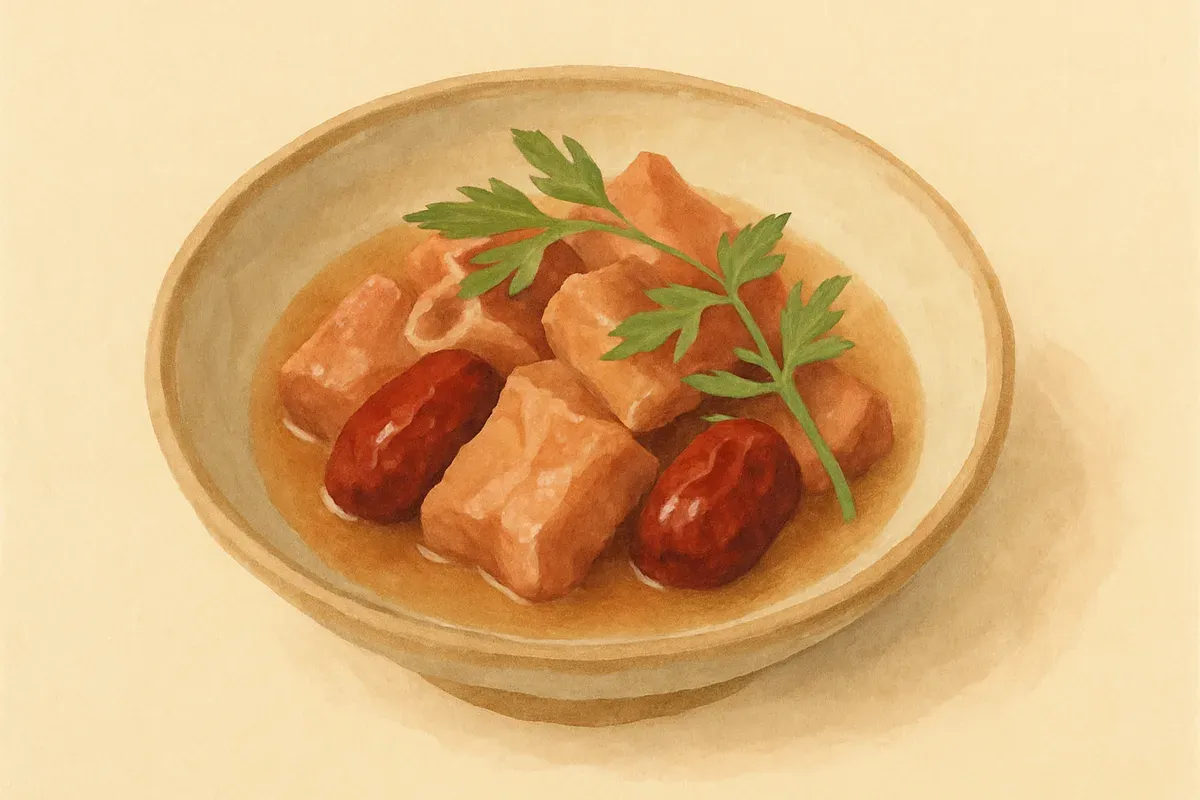
Angelica and red date steamed pork ribs (当归红枣蒸排骨)
Pork ribs steamed with dang gui and red dates. A gentler way to take the classic blood nourishing herbs than a long boiled tonic soup.
Most people meet dang gui in a large pot of tonic soup. Steaming it with pork ribs is the gentler introduction: the same herbs, a fraction of the volume, and a dish that reads as dinner rather than medicine.
Why this dish
The confinement kitchen returns to blood again and again, because in the traditional view blood is what birth has spent. Dang gui is the herb most associated with rebuilding it, and red dates are its usual companion, both for sweetness and because the tradition uses them to soften stronger herbs.
Pairing them with pork ribs turns a formula into food. The ribs bring protein and richness, and the steaming keeps everything concentrated in a small amount of intensely savoury liquid rather than diluted across a soup pot.
A note on dose
This is the one recipe on the site where the amount of a single ingredient really matters. Two or three thin slices of dang gui is right for 600 g of ribs. Doubling it does not make the dish more nourishing; it makes it taste like a herbal decoction, and most people will not finish it.
Buy the slices from a Chinese herbalist rather than a supermarket, where the quality is more variable and the pieces are often too thick to portion sensibly.
For the framework these herbs belong to, see qi, blood, cold and wind, and for where tonifying dishes sit in the month, how the 30 days are structured.
The recipe
- Prep
- 20 min
- Cook
- 45 min
- Total
- 1 hr 5 min
- Serves
- 3 to 4 as part of a meal
Why this ingredient
Chinese angelica (当归)
The most widely used blood tonic in Chinese medicine, sometimes called female ginseng for how often it appears in womens formulas. In TCM it is said to both nourish and move blood, which is why it is central to postpartum recovery, where the tradition sees blood as depleted and stasis as something to clear. It is genuinely potent, which is why a couple of slices is the right dose rather than a handful.
Why this ingredient
Red dates (红枣)
Said to tonify qi and nourish blood, and used across Chinese cooking to harmonise a formula, meaning to soften and round out anything sharp or strong beside it. That is exactly their job here: they take the medicinal edge off the dang gui and make the dish taste like food rather than tonic.
Ingredients
- 600 g pork ribs, cut into short lengths Ask the butcher to chop them into 4 cm pieces so they steam evenly.
- 2 to 3 thin slices dried dang gui (Chinese angelica root) A small amount only. The flavour is strong, sweet and medicinal, and too much overwhelms the dish.
- 6 dried red dates, halved and stones removed Sweeten the dish and soften the herbal edge of the dang gui.
- 1 tablespoon goji berries Added in the last ten minutes so they stay whole.
- 20 g ginger, finely julienned Warming, and it cuts the richness of the pork.
- 1 tablespoon rice wine Part of the marinade. Mostly steams off.
- 1 tablespoon light soy sauce and 1 teaspoon cornflour The cornflour holds the juices around the ribs rather than letting them pool and thin.
- Pinch of salt and white pepper White pepper is warming in the traditional view and suits confinement cooking better than black.
Method
- 1 Rinse the ribs and pat them dry. Combine with the soy sauce, rice wine, cornflour, salt and white pepper, and leave to marinate for 15 minutes.
- 2 Rinse the dang gui slices, red dates and goji berries briefly in cool water.
- 3 Arrange the ribs in a single layer in a shallow heatproof dish. Tuck the dang gui slices, red dates and half the ginger among them.
- 4 Bring water to a hard boil in a steamer. Put the dish in, cover, and steam over medium high heat for 35 minutes.
- 5 Add the goji berries and the remaining ginger, and steam for a further 10 minutes until the ribs are tender and pulling from the bone.
- 6 Taste the juices and adjust with a little salt. Serve directly from the dish, spooning the juices over rice.
Notes and substitutions
- Buy dang gui from a Chinese herbalist or medical hall rather than a supermarket, and ask for thin slices rather than a whole root, which is difficult to portion at home.
- Two or three slices is genuinely enough for 600 g of ribs. The most common mistake is using so much that the dish tastes like medicine.
- Blanching the ribs for two minutes first gives a cleaner tasting dish if you prefer it very clear, though it costs a little flavour.
- Steaming rather than boiling keeps everything in the dish. Serve the juices; they are the best part.
Before you cook this
- Dang gui is a potent herb rather than a culinary aromatic. It is traditionally avoided while bleeding is still heavy, and it may not suit you if you take blood thinning medicines, so check with a TCM practitioner or your pharmacist before using it.
- Households usually leave dang gui until after the first stage of the month, once lochia has begun to settle.
Common questions
What does dang gui taste like?
Strongly aromatic, sweet and slightly bitter, with a distinctly medicinal note that people either love or find overpowering. Used sparingly and balanced with red dates it reads as warm and savoury rather than like medicine.
When in the month can I eat this?
Most households place it in the second stage, roughly days 11 to 20, once lochia has lightened. Dang gui is traditionally held back while bleeding is still heavy because it is understood to move blood.
Can I make it without dang gui?
Yes, and it is still a good dish. Steam the ribs with red dates, goji and ginger alone for something gentler and more everyday, suitable at any stage of the month.
Why steam rather than make it into a soup?
Steaming concentrates. Everything the herbs and pork release stays in the dish rather than dispersing into two litres of liquid, so you get the flavour and the nourishment in a few spoonfuls of intense juices.