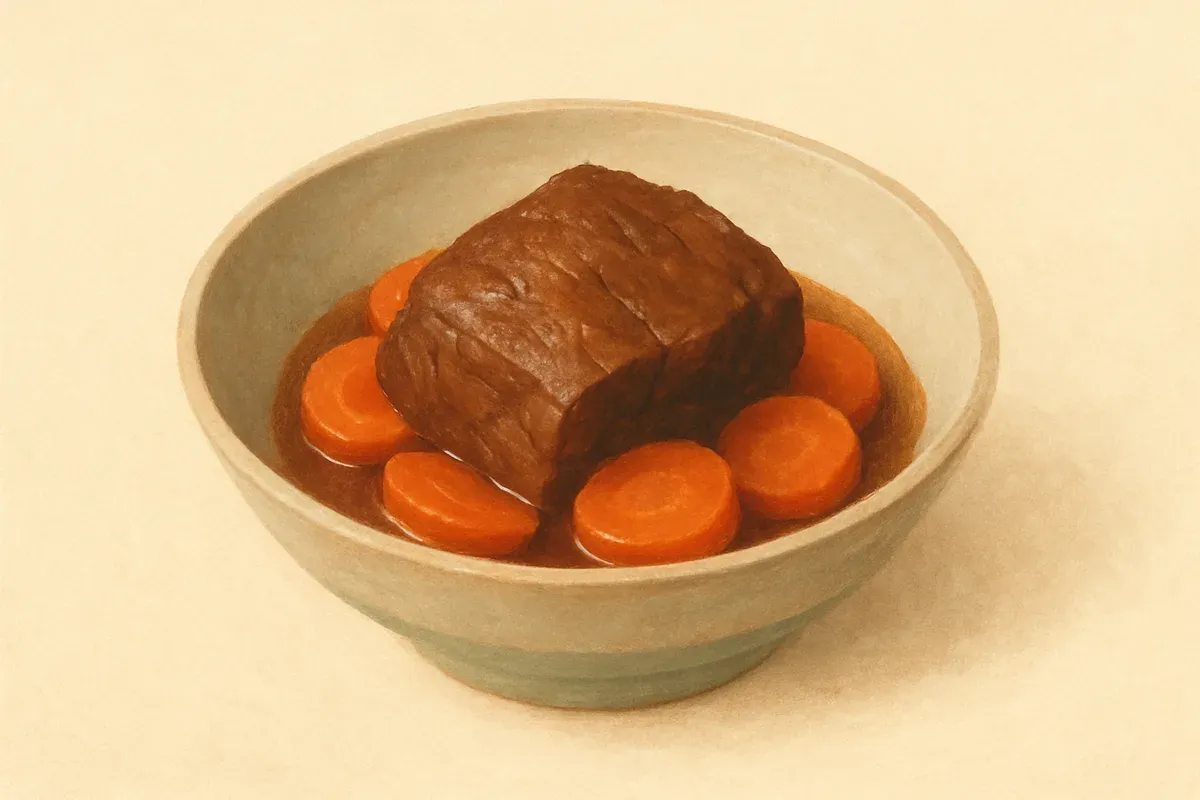
Slow-braised beef with carrots (萝卜炆牛腩)
luo bo men niu nan (萝卜炆牛腩)
Beef and carrots braised slow with star anise and ginger until tender. A warming, blood nourishing dish for building strength in the later weeks.
Beef appears less often than pork or chicken in the confinement kitchen, but it earns a place in the later weeks, when the month turns towards rebuilding strength. Braised slow with carrots, ginger and warming spice, it is honest, restorative cooking.
Why this dish
The tradition classes beef as warming and strengthening, and its richness places it among the blood nourishing foods too. That makes it food for the rebuilding stage rather than the delicate first days. Ginger and star anise carry the warmth, and the carrots add a soft sweetness that balances the depth of the meat.
Patience is the recipe
There is no shortcut. A tough cut and a long, gentle braise are what give you tender beef and a glossy sauce; rushing it with high heat only tightens the meat. Make it ahead if you can, since it is better still the next day.
For the ideas behind warming, blood nourishing food, see qi, blood, cold and wind.
The recipe
- Prep
- 20 min
- Cook
- 1 hr 40 min
- Total
- 2 hr
- Serves
- 4 as part of a meal
Why this ingredient
Beef (牛肉)
Beef is classed in the tradition as warming and strengthening, valued for building energy and, being rich and red, grouped with the foods thought to nourish blood. It appears less often than pork and chicken in confinement cooking but earns its place in the later weeks, when the focus turns to rebuilding strength, and its iron content is a plain modern reason the instinct holds.
Why this ingredient
Old ginger (老姜)
In a long braise ginger works slowly, warming the dish from within and softening the heaviness of red meat. The tradition treats it as indispensable to warming food, and here a few coins simmered through the braise round the beef and keep it from feeling too rich.
Ingredients
- 600 g beef brisket or chuck, cut into large chunks A cut with some connective tissue, which is what turns silky over a long braise.
- 2 carrots, cut into rolling chunks Added partway so they soften without collapsing.
- 30 g ginger, sliced For warmth and to round the flavour of the beef.
- 2 star anise and a small piece of cinnamon Warming spices that give the braise its depth.
- 2 tablespoons oyster sauce, 1 tablespoon light soy and 1 teaspoon dark soy The savoury base, with dark soy for colour.
- 600 ml water and 1 teaspoon rock sugar Enough to cover; the sugar rounds the sauce.
Method
- 1 Blanch the beef in boiling water for 3 minutes, then drain and rinse to remove scum.
- 2 In a heavy pot, fry the ginger and rock sugar in a little oil until the sugar melts and turns amber.
- 3 Add the beef and turn to colour it, then add the star anise, cinnamon, oyster sauce, both soy sauces and the water.
- 4 Bring to the boil, lower to a bare simmer, cover, and braise for 60 minutes.
- 5 Add the carrots and continue braising for another 30 to 40 minutes, until the beef is fork-tender and the carrots are soft.
- 6 Uncover and reduce the sauce until glossy. Lift out the spices and serve hot over rice or with noodles.
Notes and substitutions
- Like most braises it is better the next day, so make it ahead if you can and skim the set fat before reheating.
- A few pieces of daikon braised alongside the carrots suit the dish well and add bulk.
- Keep the simmer gentle; a hard boil tightens the beef before the connective tissue softens.
Before you cook this
- A rich, strengthening dish the tradition places in the later weeks rather than the delicate early days. Serve it in modest portions with greens and rice.
Common questions
Is beef eaten during confinement?
Yes, though less often than pork and chicken. It is classed as warming and strengthening and, being rich and red, is grouped with blood nourishing foods, which makes it a natural choice for the later weeks when the focus is on rebuilding strength.
Which cut is best for braising?
A cut with some connective tissue, such as brisket or chuck, which turns tender and silky over a long, gentle braise. Lean cuts stay firm and dry, so they are not the right choice here.
How do I know when it is done?
When the beef is fork-tender and pulls apart easily, and the carrots are soft. If it still feels tight, it simply needs longer at a gentle simmer; braises reward patience.