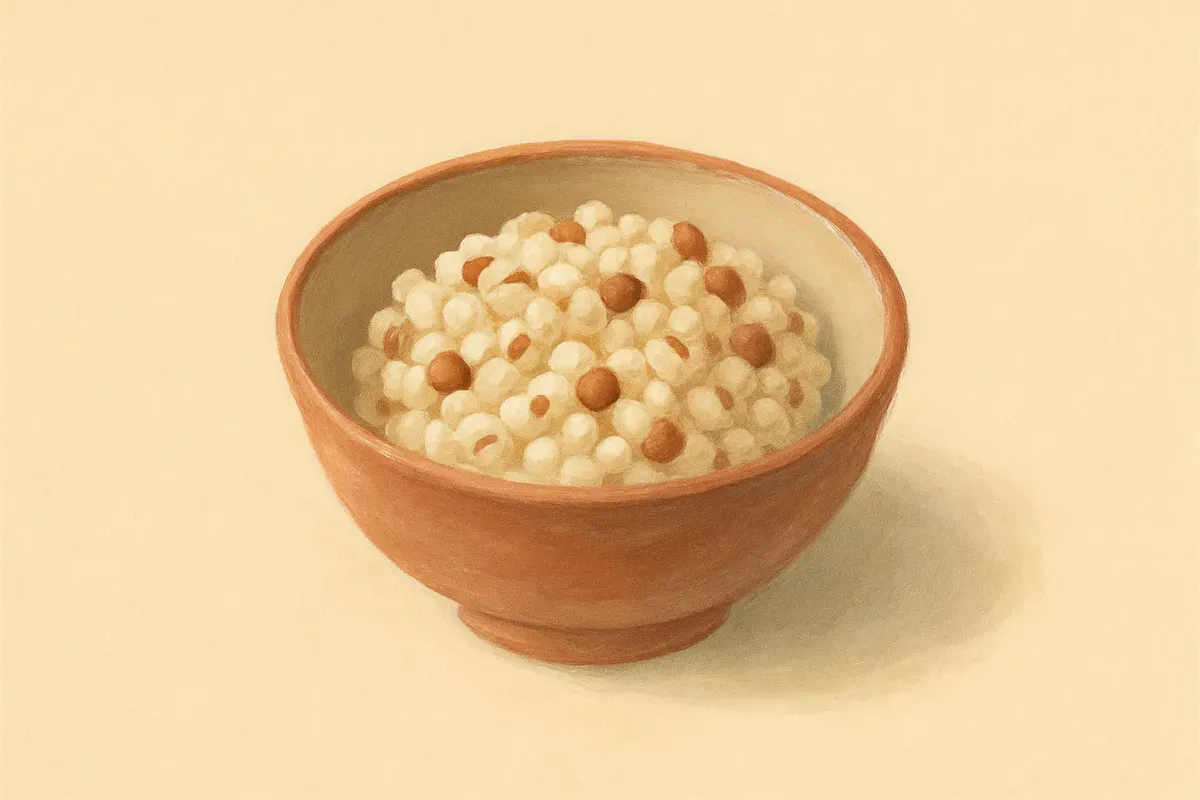
Coix and job’s tears rice (薏米饭)
yi mi fan (薏米饭)
Everyday rice cooked with job’s tears and red dates for a gently nourishing staple. A simple way to bring a traditional grain into daily meals.
Rice is the quiet backbone of every confinement meal, and cooking it with a handful of job’s tears is one of the simplest ways to make it work a little harder. It takes no more effort than ordinary rice, and it brings a traditional tonic grain into daily eating.
Why this dish
Job’s tears is valued in the tradition mainly for helping the body drain damp, a concept it links to the puffiness and heaviness that can follow birth. It is one of the gentlest tonic grains, mild enough to eat every day, and cooking it into rice with a few red dates is the least fussy way to include it.
Soak it first
The one thing to remember is the soak. Job’s tears is far harder than rice, so a few hours in water lets the two cook in step. Soak a batch and freeze it in portions, and it becomes something you can add to any pot of rice without a second thought.
For the tonic ingredients of the month, see qi, blood, cold and wind.
The recipe
- Prep
- 10 min
- Cook
- 30 min
- Total
- 40 min
- Serves
- 3 to 4 as part of a meal
Why this ingredient
Job’s tears (薏米)
Job’s tears, also called coix seed or Chinese pearl barley, is a chewy grain the tradition values chiefly for helping the body drain damp, a concept it links to sluggishness and puffiness. It is one of the gentlest and most everyday of the tonic grains, which is why it is cooked simply into rice and porridge, and its mild, nutty flavour makes it easy to eat daily.
Why this ingredient
Red dates (红枣)
Red dates thread through the confinement kitchen as a sweet, blood nourishing addition, and cooked into rice they soften and lend a mild sweetness. Pairing them with job’s tears is a common way to round the grain’s plainness and add a little of the blood nourishing intent the month is built around.
Ingredients
- 200 g white or brown rice, rinsed The everyday base; brown rice needs a little more water and time.
- 50 g job’s tears (coix seed), soaked for a few hours Soaking softens the hard grain so it cooks in step with the rice.
- 4 red dates (jujubes), pitted and torn For a gentle sweetness and a blood nourishing note.
- 1 tablespoon goji berries (optional) Stirred in at the end so they stay whole.
- Water, to the usual level for your rice A little extra to account for the job’s tears.
Method
- 1 Soak the job’s tears in water for a few hours, or overnight, so it softens; it is much harder than rice and needs the head start.
- 2 Rinse the rice and drain the job’s tears. Combine them in a rice cooker or pot with the torn red dates.
- 3 Add water to your usual level for rice, plus a little extra for the job’s tears.
- 4 Cook as you would normal rice. If using a pot, bring to the boil, then cover and cook on low for about 20 minutes until the water is absorbed.
- 5 Stir in the goji berries, if using, fluff, and rest for 5 minutes before serving.
Notes and substitutions
- Soak a big batch of job’s tears and freeze it in portions so it is ready to add to rice or congee any day.
- For a softer result, cook it into a congee with more water instead of as rice.
- Job’s tears is sold as coix seed or Chinese pearl barley at Chinese grocers; it is not the same as ordinary pearl barley, though that is a passable substitute.
Before you cook this
- Job’s tears is a food-grade grain, but it is traditionally used with some care in pregnancy; in the postpartum period it is eaten freely. If you have any concern, check with a practitioner.
Common questions
What is job’s tears?
Job’s tears, or coix seed, is a chewy grain also sold as Chinese pearl barley. The tradition values it mainly for helping the body drain damp, and it is one of the most everyday of the tonic grains, cooked simply into rice, congee and soups.
Is it the same as pearl barley?
Not exactly. Job’s tears (coix) is a distinct grain, larger and rounder, though it is often labelled Chinese pearl barley. Ordinary pearl barley is a reasonable substitute in texture, but for the traditional properties, look for coix seed specifically.
How do I work it into meals?
The easiest way is to cook it with your everyday rice, as here. It can also go into congee or into the tonic soups of the month. Soaking it first, and cooking a batch to freeze, makes it simple to include regularly.